
When a customer visits our factory looking for a liquid filling machine for HDPE containers, the first thing we normally ask is very simple:
“Sir, what product are you filling, in which bottle, and how much production do you require?”
These three things give us a starting point.
Many customers come with a requirement such as, “We have a 1 litre HDPE bottle and we want an automatic filling machine.” But only knowing the bottle size is not enough to finalize a filling machine.
We need to understand the liquid, filling quantity, bottle dimensions, production speed, and what type of packaging line the customer is planning.
So, when a customer visits WFM Machinery, we generally explain the machine step by step.

First, We Understand the Product
Before discussing the machine, we check the product.
For example, whether the liquid is:
- Water-like
- Oil-based
- Thick or viscous
- Foaming
- Chemical
- Corrosive
- Sticky
- Temperature-sensitive
This is important because the same filling system cannot be used for every type of liquid.
For example, filling a thin liquid and filling a thick lubricant are two different applications. The filling principle, pump selection, nozzle design, and filling speed can change according to the product.
That is why we normally ask the customer to bring a product sample or send the product details before finalizing the machine.
Then We Check the HDPE Container
After understanding the product, we check the HDPE container.
We look at the bottle:
- Height
- Diameter
- Neck size
- Mouth opening
- Shape
- Weight
- Filling capacity
Sometimes the customer has a standard round HDPE bottle. Sometimes the container is square, rectangular, or has a special shape.
The bottle has to be positioned properly below the filling nozzle. If the container is not stable during filling, it can affect the filling process.
So, during a factory visit, we normally take the customer’s actual bottle and check how it will run on the machine.
How the Liquid Filling Machine Works
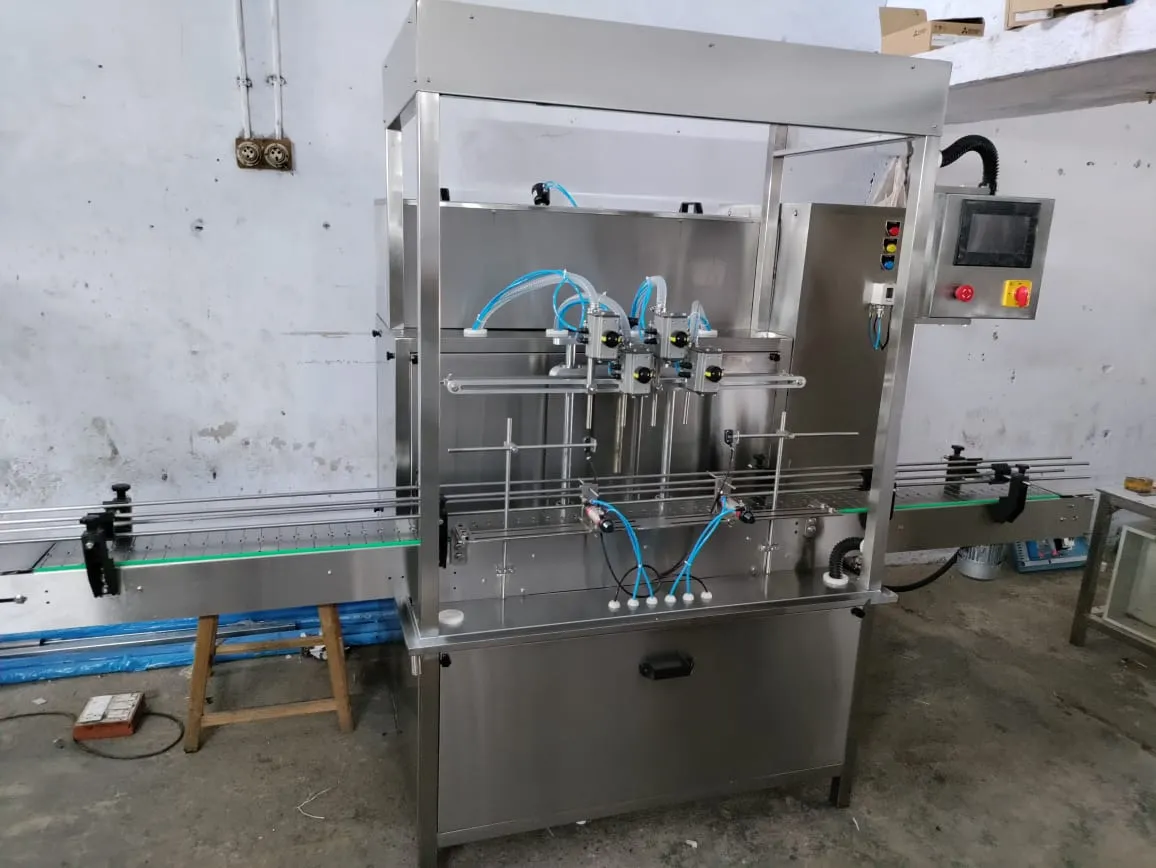
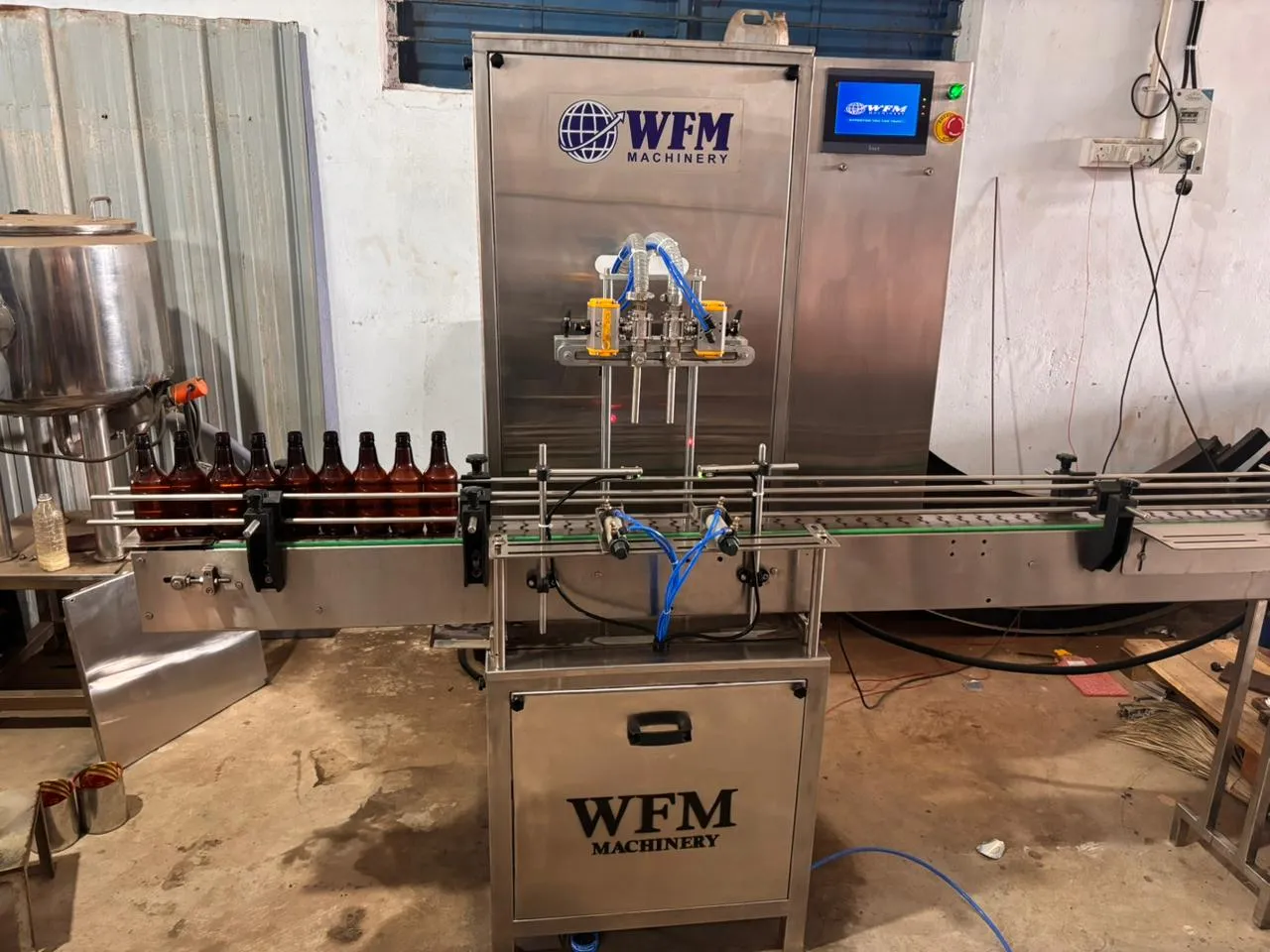
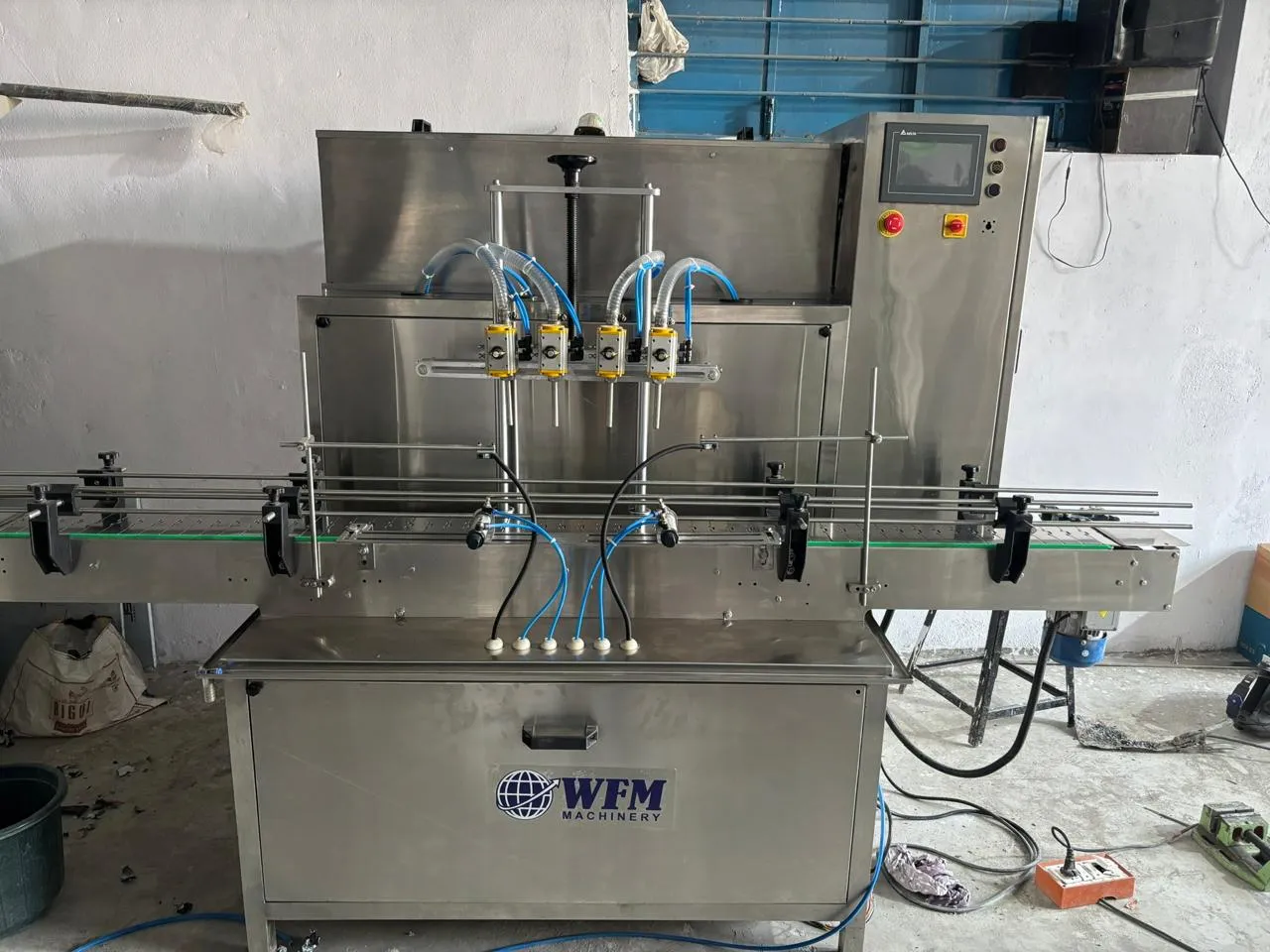
Once the customer understands the basic requirements, we show the actual working of the machine.
The process is quite straightforward.
The empty HDPE containers come through the conveyor.
The bottles are then stopped and positioned at the filling station. Once the bottles are correctly positioned, the filling nozzles come into the filling position.
The machine fills the required quantity of liquid into the containers.
After filling is completed, the nozzles move back and the filled containers continue on the conveyor.
From there, the bottles can go to the capping machine, labeling machine, batch coding machine, and other packaging equipment.
So the complete process can be:
HDPE Container → Conveyor → Liquid Filling → Capping → Labeling → Batch Coding → Packing
How Many Filling Heads Are Required?
This is one of the common questions customers ask during a factory visit.
The number of filling heads depends mainly on the required production.
Suppose the customer has a requirement of only a few hundred bottles per hour. A smaller filling arrangement may be sufficient.
But if the requirement is several thousand bottles per hour, we need to consider more filling heads and a suitable conveyor speed.
For example, instead of making one nozzle do all the work, multiple filling heads can fill multiple bottles during the same cycle.
This increases the output without unnecessarily increasing the filling time.
The final number of heads is decided after considering the product, bottle size, filling volume, and required production speed.
What About Filling Accuracy?
Normally, the next question from the customer is:
“How accurate will the filling be?”
This depends on the filling system selected for the particular product.
The machine is designed to deliver a controlled quantity of liquid into each container. Depending on the application, different filling principles can be considered, such as volumetric, piston-based, flow-meter-based, or other suitable systems.
During trials, we check the actual product and actual bottle rather than depending only on theoretical calculations.
This is important because product behaviour can be different from what we expect on paper.
What Happens if the Product Is Foaming?
This is another practical issue we discuss with customers.
Some detergents, cleaners, chemicals, and other liquids can create foam while filling.
If the filling speed is too high, the product may foam excessively and overflow from the bottle.
In such applications, we may need to adjust the filling speed, nozzle arrangement, filling sequence, or other machine parameters.
The purpose is not simply to achieve the highest possible speed. The filling should be stable and suitable for the product.
What If the Liquid Is Thick?
For thick liquids, the situation is different.
Products such as certain oils, lubricants, syrups, and other viscous liquids do not flow in the same way as water.
In such cases, the filling system needs to be selected according to the viscosity of the product.
This is why we prefer to test the customer’s actual product whenever possible.
During the trial, we can see:
How the product flows → How quickly it fills → How the nozzle behaves → Whether there is dripping → What filling speed is practical
This gives a much better understanding before the machine is finalized.
What About Machine Cleaning?
Customers also ask about cleaning and maintenance.
This becomes particularly important when the machine is used for products that need frequent changeover.
The product-contact parts should be accessible for cleaning and maintenance. The exact construction and material selection depend on the product and application.
For chemical products, for example, material compatibility needs to be considered carefully.
The machine should not only work properly when it is new; it should also be practical for the operator to maintain on a daily basis.
PLC and Touchscreen Operation
In an automatic machine, the operator should not have to manually control every filling cycle.
The machine can be operated through a PLC-based control system and touchscreen interface.
The operator can set parameters such as filling quantity and other relevant machine settings depending on the machine configuration.
Once the correct parameters are set, the machine can operate automatically with the conveyor and filling system working together.
For the customer, the main advantage is easier operation and better control over the production process.
Can the Same Machine Handle Different HDPE Bottle Sizes?
This depends on the machine design and the range of bottles required.
If a customer is using, for example, 500 ml, 1 litre, and 2 litre HDPE containers, the machine can be designed with suitable changeover arrangements.
However, we always recommend that the customer provides all the bottle samples during the machine finalization stage.
It is better to check all required bottle sizes at the factory rather than finding compatibility issues after installation.
What Production Capacity Can Be Achieved?
Production capacity depends on several factors.
It is not correct to say that every liquid filling machine will produce a fixed number of bottles per minute.
The actual output depends on:
- Filling volume
- Product viscosity
- Number of filling heads
- Bottle dimensions
- Filling speed
- Foaming characteristics
- Conveyor speed
- Loading and unloading arrangement
- Required filling accuracy
Therefore, when a customer tells us, “I need 2,000 bottles per hour,” we calculate the machine configuration according to the actual application.
From Filling Machine to Complete Packaging Line
During a factory visit, customers often start with a filling machine requirement and later discuss the complete packaging line.
For HDPE containers, a complete line may include:
Bottle Feeding → Liquid Filling → Capping → Labeling → Batch Coding → Collection/Packing
Depending on the production requirement, these machines can be connected with conveyors to create a continuous automatic process.
This reduces manual handling between different packaging operations.
What We Recommend Before Finalizing the Machine
From our experience, we always recommend customers to provide the following information before finalizing a liquid filling machine:
1. Product sample or complete product details
2. HDPE bottle samples
3. Filling quantity
4. Required production per hour
5. Number of different bottle sizes
6. Product viscosity
7. Whether the product foams
8. Required level of automation
Once these details are available, the machine can be designed much more accurately according to the customer’s actual requirement.
A Factory Trial Gives a Better Understanding
One of the most useful parts of a customer visit is the machine trial.
Instead of only discussing specifications, the customer can actually see the machine running.
The customer’s HDPE bottles can be placed on the conveyor, the actual liquid can be filled, and the filling process can be observed.
This gives the customer a clear idea about:
- Filling speed
- Filling accuracy
- Bottle handling
- Nozzle operation
- Machine controls
- Operator requirements
- Changeover process
- Overall machine working
For us also, the trial helps in understanding the application properly.
Final Discussion With the Customer
After the trial, we discuss the machine configuration with the customer.
At this stage, the important points are normally:
What is the required output?
What filling quantity is required?
How many bottle sizes are there?
Is the machine required to be automatic or semi-automatic?
Does the customer need capping and labeling integration?
What is the future production requirement?
These points help us arrive at a practical machine configuration instead of simply selecting a standard machine.
Conclusion
A liquid filling machine for HDPE containers may look like a simple machine from outside, but there are many practical factors involved in selecting the correct filling system.
The product, bottle, filling quantity, viscosity, production requirement, and future expansion all need to be considered.
When a customer visits our factory, we prefer to understand the complete requirement first, test the product and container where required, and then suggest the suitable machine configuration.
At WFM Machinery, our focus is to provide a filling solution that works properly with the customer’s actual product and HDPE container—not just a machine based on catalogue specifications.
If you are planning an automatic liquid filling line for HDPE containers, you can share your product details, bottle sample, filling quantity, and required production capacity with WFM Machinery. Based on these details, the appropriate filling system and machine configuration can be discussed.