
In modern bottling and packaging plants, production efficiency depends heavily on continuous and correctly oriented bottle feeding. An automatic rotary bottle unscrambler is designed to receive randomly positioned bottles and discharge them upright in a synchronized, controlled manner to the filling line.
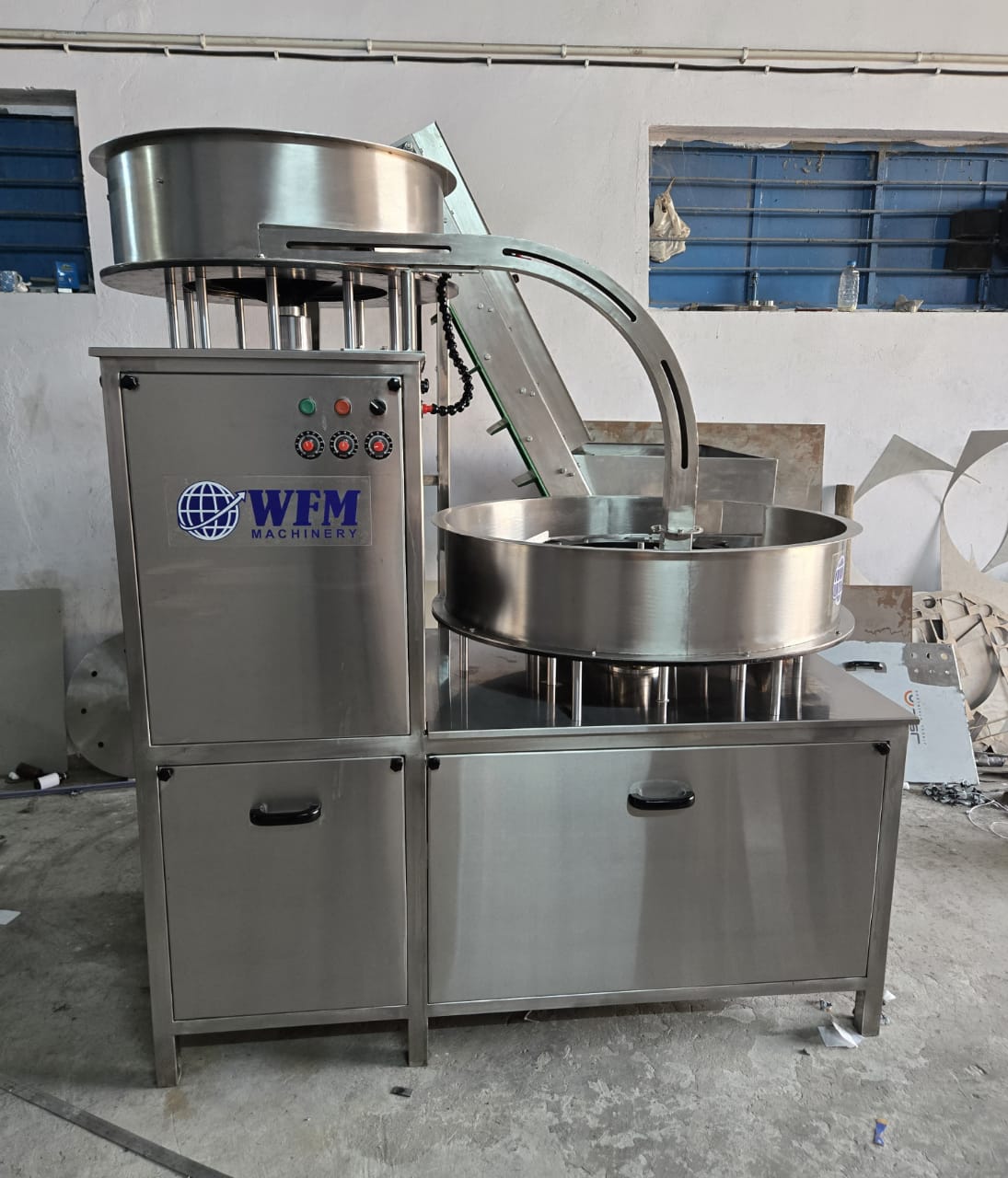
Understanding the working principle of an automatic rotary bottle unscrambler helps manufacturers select the right system and optimize bottling line performance.
At WFM Machinery, we design and manufacture fully automatic rotary bottle unscrambling systems engineered for high-speed, stable, and reliable operation. This guide explains in detail how these machines function.
What Is an Automatic Rotary Bottle Unscrambler?
An automatic rotary bottle unscrambler is a machine installed at the beginning of a bottling line. Its primary function is to:
-
Accept bulk-loaded bottles
-
Separate and orient them correctly
-
Discharge bottles upright onto the conveyor
-
Maintain continuous feeding synchronized with the filling machine
The system eliminates manual bottle placement and ensures consistent bottle flow into downstream equipment.
Main Components of an Automatic Rotary Bottle Unscrambler
To understand the working principle, it is important to know the major components involved in the process.
Bottle Infeed Hopper
Bottles are loaded randomly into a hopper. In fully automatic systems, bottles are often fed through an elevator or bulk loading system into the rotating disc chamber.
Rotary Disc (Centrifugal Plate)
The heart of the machine is a rotating circular disc. This disc creates centrifugal motion that spreads bottles outward toward orientation channels.
Orientation System
Orientation mechanisms separate upright bottles from incorrectly positioned ones. This system may include:
-
Guide rails
-
Bottle slots
-
Orientation pockets
-
Air blow mechanisms
-
Mechanical rejection channels
Discharge Conveyor
Correctly oriented bottles are transferred smoothly to the exit conveyor, where they move toward the filling machine.
PLC and Control Panel
A programmable logic controller (PLC) manages speed, synchronization, sensor detection, and alarm systems. The HMI allows operators to adjust parameters.
Step-by-Step Working Principle
The working process of an automatic rotary bottle unscrambler follows a systematic sequence.
Bottle Loading
Empty bottles are loaded into the hopper in bulk. The bottles are in random positions — some upright, some sideways, some inverted.
The machine is designed to handle this randomness efficiently.
Rotational Spreading
Once bottles enter the rotary disc chamber, the disc begins rotating. Centrifugal force spreads the bottles toward the outer perimeter of the rotating plate.
This outward movement prevents bottle clustering and ensures uniform distribution.
Bottle Alignment and Separation
As bottles move along the perimeter, they enter specifically designed orientation channels.
These channels are engineered according to bottle shape and dimensions. Only upright bottles fit properly into the discharge path.
Incorrectly oriented bottles are redirected back into the disc for re-circulation.
This continuous recirculation ensures that only properly positioned bottles exit the machine.
Controlled Discharge
Upright bottles are guided into a single-lane discharge path.
Sensors detect bottle flow and coordinate speed with the filling line. If the downstream machine slows down or stops, the unscrambler adjusts automatically.
This prevents bottle pile-up or conveyor congestion.
Synchronization with Filling Line
The PLC system ensures the unscrambler speed matches the filler’s operating speed.
Advanced systems use variable frequency drives (VFDs) for precise speed control.
This synchronization maintains smooth, continuous bottle feeding.
Role of Centrifugal Force in Rotary Systems
The rotary principle relies heavily on centrifugal motion.
When the disc rotates:
-
Bottles move outward naturally
-
Bottles align along the circular track
-
Bottle collisions are minimized
-
Continuous movement is maintained
This principle allows high-speed operation without complex robotic mechanisms.
It is especially effective for PET and HDPE bottles.
Automation and Sensor Integration
Modern automatic rotary bottle unscramblers use intelligent sensors to ensure stability.
Common sensor functions include:
-
Bottle presence detection
-
Jam detection
-
Exit conveyor monitoring
-
Emergency stop triggering
-
Speed synchronization
The PLC system constantly monitors bottle flow and adjusts motor speed to maintain optimal discharge.
This automation improves reliability and reduces operator intervention.
Handling Different Bottle Types
The working principle remains consistent, but machine configuration varies based on bottle characteristics.
PET Bottles
Lightweight PET bottles require smooth guiding and controlled rotation to prevent deformation.
HDPE Bottles
HDPE bottles are generally stronger but may require modified orientation guides.
Tall Bottles
Tall bottles require stabilization during rotation to prevent tipping.
Small Bottles
Smaller bottles require precise orientation pockets to avoid double feeding.
At WFM Machinery, orientation mechanisms are customized according to bottle dimensions and production speed.
Advantages of Rotary Working Principle
The rotary mechanism offers several advantages compared to manual or linear systems.
Continuous Operation
The rotating disc allows uninterrupted bottle movement.
High-Speed Capability
Rotary systems are ideal for medium to high BPH lines.
Stable Orientation
Recirculation ensures only correctly oriented bottles are discharged.
Low Manual Intervention
Fully automatic operation reduces labor dependency.
Compact Design
Rotary machines require relatively less floor space compared to complex robotic systems.
Common Operational Challenges and Solutions
Even well-designed systems must address operational challenges.
Bottle Jamming
Proper guide rail design and sensor monitoring reduce jamming.
Bottle Deformation
Gentle handling mechanisms prevent lightweight bottle collapse.
Overfeeding
Speed synchronization prevents bottle accumulation.
Misalignment at Discharge
Precise conveyor alignment ensures smooth transfer.
Proper engineering and installation minimize these issues.
Importance of Proper Machine Sizing
The working principle is effective only when the machine is correctly sized for the application.
Oversized machines waste energy and increase costs.
Undersized machines create bottlenecks.
Production speed, bottle type, and plant layout must be evaluated before finalizing configuration.
Maintenance Considerations
To maintain optimal working performance:
-
Regularly inspect guide rails
-
Check motor and gearbox lubrication
-
Clean sensors
-
Monitor disc alignment
-
Replace worn orientation components
Preventive maintenance ensures long-term reliability.
Final Insights from WFM Machinery
The working principle of an automatic rotary bottle unscrambler is based on controlled centrifugal motion, precision orientation mechanisms, and intelligent synchronization with downstream equipment.
However, successful operation depends on:
-
Proper machine configuration
-
Accurate bottle specification analysis
-
Reliable automation integration
-
Professional installation and commissioning
At WFM Machinery, our rotary bottle unscrambling systems are engineered for stable high-speed operation across beverage, edible oil, cosmetic, pharmaceutical, and chemical industries.
Understanding the working principle helps manufacturers make informed decisions when selecting a bottle feeding system for their bottling line.
For technical consultation or detailed machine configuration guidance, our engineering team can assist in evaluating your specific production requirements.