
In modern manufacturing, speed, precision, and consistency are everything. A Pick and Place Robot is an automated robotic system designed to pick products from one location (like a conveyor) and place them into another position (such as trays, cartons, or pallets).
For companies planning to invest in packaging automation, understanding how pick and place robots work and how they improve ROI is crucial. This detailed guide will help you make the right buying decision.
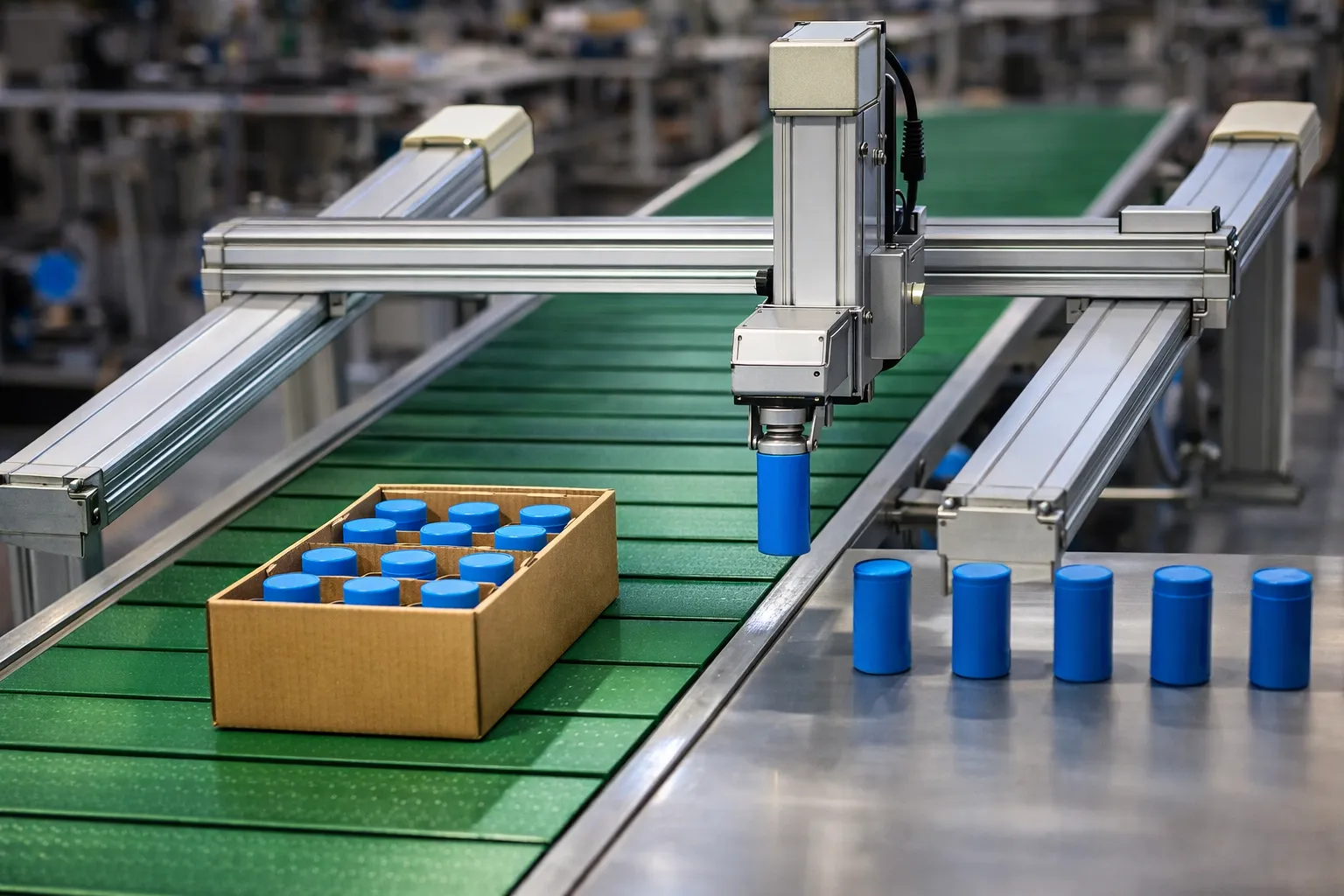
1. What Is a Pick and Place Robot?
A pick and place robot is an industrial robotic system that:
-
Detects products using sensors or vision systems
-
Picks them using grippers, vacuum cups, or clamps
-
Moves them accurately
-
Places them into packaging, trays, cartons, or pallets
These robots are widely used in:
-
Food and beverage packaging
-
Pharmaceutical packaging
-
Cosmetic industry
-
FMCG products
-
Electronics packaging
2. How Does It Work?
Here is a simplified working process:
| Step | Process | Description |
|---|---|---|
| 1 | Product Detection | Sensors or camera identify product position |
| 2 | Picking | Robot arm or delta robot picks the item |
| 3 | Positioning | Robot calculates exact placement coordinates |
| 4 | Placing | Product is placed into tray, box, or carton |
| 5 | Repeat Cycle | Process continues at high speed |
Advanced systems use vision-guided robotics for random product positioning.
3. Types of Pick and Place Robots
| Robot Type | Best For | Speed | Investment Level |
|---|---|---|---|
| Delta Robot | High-speed lightweight products | Very High | Medium–High |
| SCARA Robot | Medium speed precision tasks | High | Medium |
| 6-Axis Robot | Flexible multi-angle packaging | Medium | Medium–High |
| Gantry Robot | Heavy products, large area | Medium | High |
Buyer Tip:
For FMCG and food packaging, Delta robots are usually the best choice due to speed.
4. Key Components of a Pick and Place System
When planning to buy, ensure the system includes:
-
Robotic Arm or Delta Structure
-
Servo Motors
-
PLC Control System
-
HMI Touch Panel
-
Vision Camera (optional but recommended)
-
End Effector (Gripper or Vacuum Cup)
-
Safety Guarding
5. Major Benefits for Buyers
Increased Production Speed
-
60–150 picks per minute depending on model
-
Works 24/7 without fatigue
Labor Cost Reduction
-
Reduces dependency on manual workers
-
Saves recurring salary cost
Improved Accuracy
-
±0.1 mm precision
-
Minimal product damage
Better Hygiene (Food and Pharma)
-
Stainless steel structure
-
Reduced human contact
Scalability
-
Can integrate with existing conveyor and cartoning machines
6. Example Applications
| Industry | Application Example |
|---|---|
| Food | Biscuit tray loading |
| Pharma | Blister pack cartoning |
| Cosmetics | Bottle placement in cartons |
| FMCG | Soap bar packing |
| Electronics | PCB component placement |
7. Buyer’s Frequently Asked Questions
How much does a Pick and Place Robot cost?
Cost depends on:
-
Robot type
-
Speed requirement
-
Payload capacity
-
Vision system inclusion
-
Customization
Estimated Range in India:
₹15 Lakhs to ₹60 Lakhs and above
Custom high-speed systems may cost more.
What ROI can I expect?
Most buyers recover investment in:
-
12 to 24 months
-
Faster ROI if replacing 3 to 5 workers per shift
Example Calculation:
| Factor | Manual | Robot |
|---|---|---|
| Workers Required | 4 | 0–1 |
| Monthly Labor Cost | ₹80,000 | ₹10,000 (maintenance) |
| Annual Saving | ₹8–10 Lakhs | — |
How much space is required?
-
Compact Delta robots need minimal floor space
-
Can be mounted above conveyor
-
Suitable for small and medium factories
Is maintenance difficult?
No. Basic maintenance includes:
-
Lubrication
-
Cleaning
-
Periodic calibration
Most systems run for years with minimal downtime.
Can it integrate with my existing packaging line?
Yes. Pick and place robots can integrate with:
-
Conveyor systems
-
Cartoning machines
-
Flow wrap machines
-
Checkweighers
-
Metal detectors
Proper integration planning is important.
8. What Buyers Must Check Before Purchasing
Here is a checklist to make a safe investment:
| Checkpoint | Why It Matters |
|---|---|
| Production Speed Requirement | Avoid under or over buying |
| Product Weight | Determines robot type |
| Product Size | Impacts gripper design |
| Future Expansion Plans | Choose scalable system |
| Service Availability | Local support is critical |
| Warranty and AMC | Protects investment |
9. Common Mistakes Buyers Make
-
Choosing cheapest supplier without service support
-
Not planning for future product changes
-
Ignoring vision system when needed
-
Underestimating payload requirements
10. Why Invest Now?
The Indian packaging market is rapidly moving toward automation. Early adopters gain:
-
Competitive advantage
-
Higher output capacity
-
Better quality control
-
Lower operational cost
Final Advice for Buyers
If you are planning to invest in a Pick and Place Robot:
-
Define your production speed clearly
-
Share product samples with manufacturer
-
Ask for live demo or video proof
-
Discuss ROI calculation
-
Confirm after-sales support availability
Automation is not an expense. It is a long-term profit decision.
If you need help selecting the right model for your packaging line, WFM Machinery can assist with:
-
Custom system design
-
Speed calculation
-
ROI planning
-
Complete installation and training support
Smart Automation Starts with Smart Decisions.