
Launching an oil packaging business offers strong growth potential—but long-term success depends on selecting the right production setup from the beginning. A well-designed oil filling line ensures efficiency, consistency, and scalability, while keeping initial investment within control.
Based in Ahmedabad, the company specializes in advanced filling, capping, and labeling machinery, delivering complete packaging solutions for industries such as FMCG, food, chemicals, and lubricants.
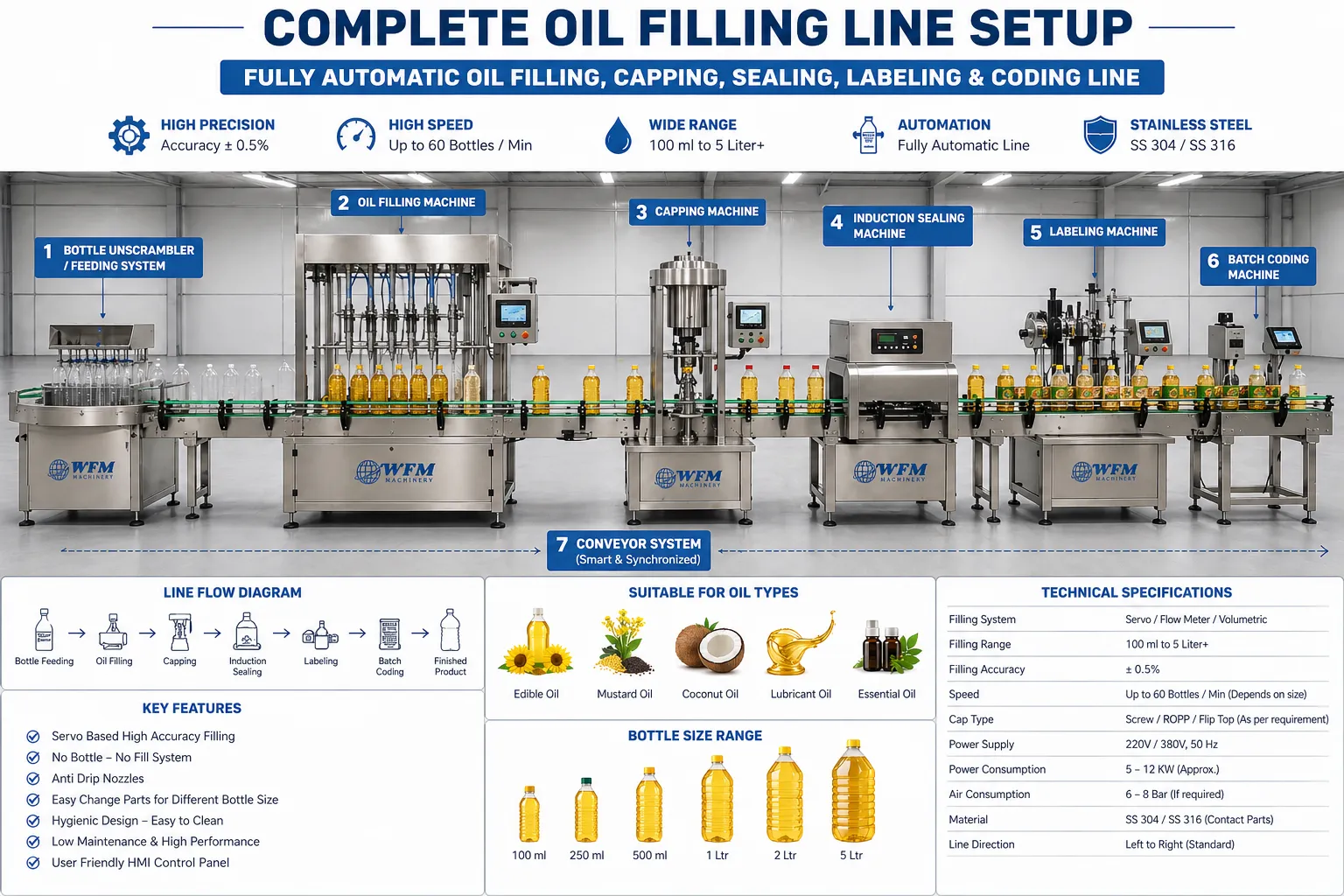
Understanding Startup Requirements
Every startup has unique production goals. Before investing in machinery, it’s important to clearly define:
- Type of oil: edible oil, lubricant, essential oil, or chemical oil
- Bottle sizes: from 100 ml to 5 liters or larger
- Production capacity: bottles per hour
- Automation level: semi-automatic or fully automatic
Starting with flexible, upgrade-ready systems is a smart strategy. It allows you to scale operations without replacing the entire production line later.
Complete Oil Filling Line Components
An efficient oil filling setup consists of multiple integrated machines working in sync:
1. Bottle Feeding System
Manual or automated systems ensure smooth and continuous bottle flow into the line.
2. Oil Filling Machine
The core component responsible for accuracy and speed. Key options include:
- Servo-based filling systems
- Flow meter-based filling
- Volumetric filling technology
- Anti-drip nozzles for clean and precise operation
High-precision filling ensures consistent output and minimal product wastage.
3. Capping Machine
Different capping solutions based on packaging requirements:
- ROPP capping
- Screw capping
- Inner and outer cap sealing
4. Induction Sealing Machine
Ensures tamper-proof, leak-proof packaging—especially essential for edible oils.
5. Labeling Machine
Automated labeling improves brand presentation and ensures regulatory compliance.
6. Batch Coding System
Prints critical information such as manufacturing date, batch number, and MRP for traceability.
7. Conveyor System
Connects all machines into a synchronized, continuous production flow.
Space & Layout Planning
Startups often operate within limited space, so efficient layout planning is crucial:
- Compact linear layouts for easy operation
- Modular design for future expansion
- Streamlined workflow to reduce manual handling
Planning with scalability in mind ensures smooth transitions as production grows.
Cost-Effective Setup for Startups
Estimated investment ranges:
- Semi-automatic line: ₹3–6 lakh
- Fully automatic line: ₹8–20 lakh+
Rather than overspending, the focus should be on selecting the right configuration that maximizes return on investment.
Hygiene & Compliance Standards
For edible oil packaging, hygiene is non-negotiable. Machines should feature:
- SS 304 or SS 316 contact parts
- Easy-to-clean construction
- Food-grade compliance compatibility
These factors ensure product safety and adherence to industry regulations.
Scalability & Future Expansion
Modern oil filling lines are designed for growth:
- Upgrade from semi-automatic to fully automatic systems
- Increase filling heads to boost production capacity
- Integrate advanced automation modules
A modular setup protects your investment and supports long-term expansion.
Why Startups Prefer Structured Line Setup
- Customized solutions tailored to business size
- Precision-engineered and reliable machinery
- Strong installation and after-sales support
- Seamless production line integration
A properly planned system not only improves productivity but also reduces operational costs over time.
Conclusion
Setting up an oil filling line is more than just purchasing machinery—it’s about building a strong operational foundation for your brand. With the right planning and equipment, startups can achieve high efficiency, consistent quality, and sustainable growth.
Get in touch today to design a customized oil filling line tailored to your startup needs.