
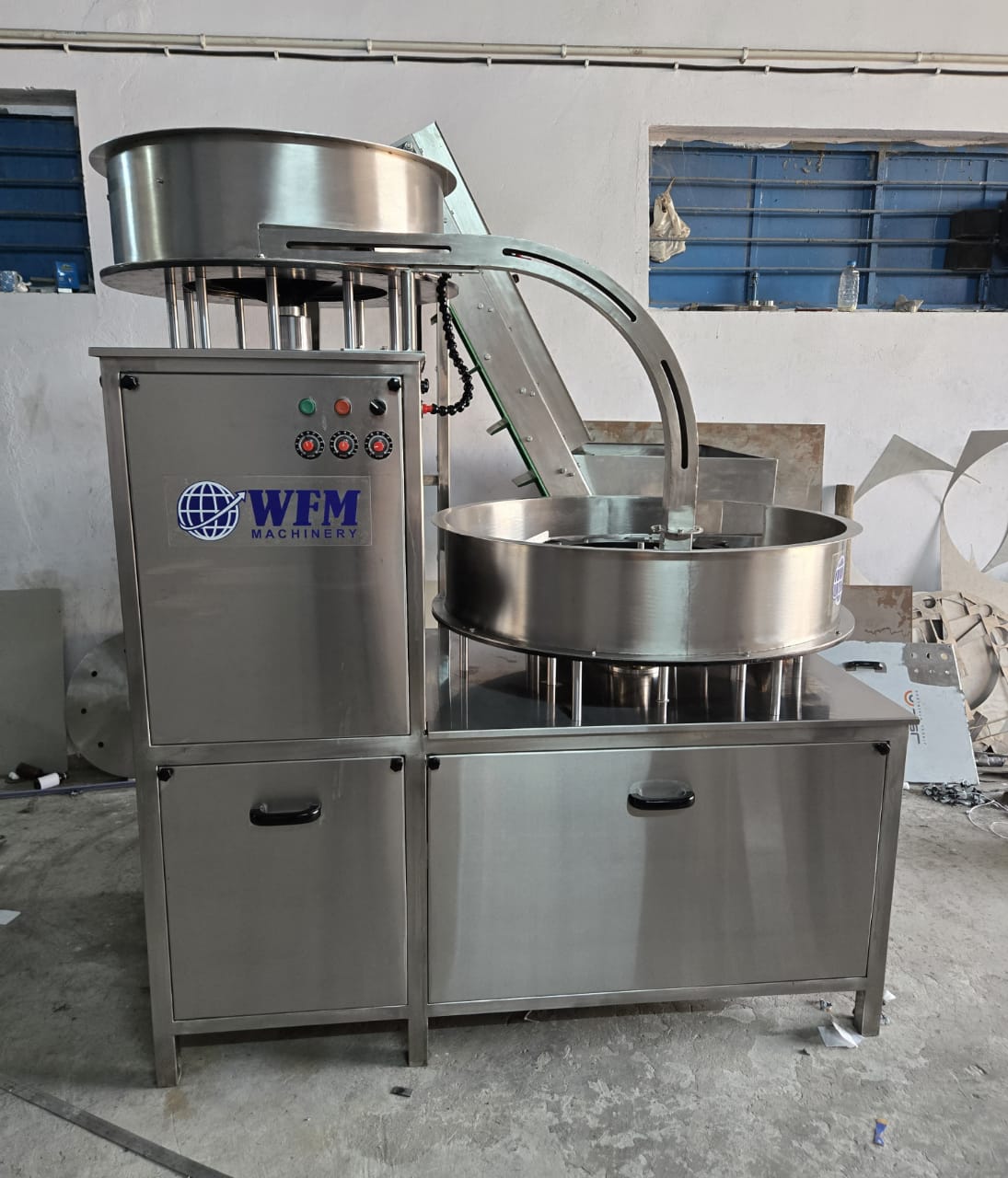
Bottle feeding is the starting point of every bottling line. If feeding is unstable, the entire production system slows down — filling becomes inconsistent, capping misaligns, labeling accuracy drops, and downtime increases.
For manufacturers in pharmaceutical, beverage, cosmetic, chemical, and FMCG industries, choosing between manual bottle feeding and fully automatic bottle feeding is not just an operational decision — it is a financial decision that impacts long-term profitability.
This guide explains the real cost comparison, operational differences, and investment logic in clear, practical terms.
What Is Manual Bottle Feeding?
Manual bottle feeding involves operators physically placing bottles onto the conveyor before filling.
It is typically used in:
• Small-scale production units
• Low BPH lines
• Pilot plants
• Start-ups
While the initial equipment investment is minimal, manual feeding creates recurring operational costs that increase over time.
What Is Fully Automatic Bottle Feeding?
A fully automatic bottle feeding system, usually through an automatic bottle unscrambler, performs the following:
• Accepts bottles in bulk
• Orients them upright
• Aligns them precisely
• Feeds them at controlled pitch
• Synchronizes with filling machine speed
The result is continuous, stable, and predictable production flow with minimal human intervention.
Direct Cost Comparison Overview
| Cost Factor | Manual Feeding | Fully Automatic Feeding |
|---|---|---|
| Initial Equipment Cost | Minimal | Capital Investment Required |
| Labor Cost | High (Recurring) | Significantly Lower |
| Downtime Risk | Higher | Reduced |
| Production Stability | Inconsistent | Stable & Predictable |
| Changeover Time | Longer | Faster |
| Scalability | Limited | Designed for Expansion |
| Long-Term Operating Cost | High | Controlled & Optimized |
Manual feeding appears economical at the start. Over time, recurring labor and downtime costs outweigh the savings.
Realistic Monthly Cost Illustration
Consider a mid-scale plant operating at:
• 2,000 bottles per hour (BPH)
• 8-hour shift
• 25 working days per month
Total monthly production =
2,000 × 8 × 25 = 400,000 bottles
Manual Feeding – Cost Factors
Labor Requirement
Most manual systems require 3–4 operators per shift.
Assume fully loaded labor cost (salary + statutory benefits + allowances) ranges between ₹20,000–₹25,000 per operator.
If 4 operators are paid ₹22,000 average:
Monthly labor cost ≈ ₹88,000
Downtime Impact
Manual feeding commonly results in 1–3% downtime depending on bottle type and operator consistency.
Assume conservative 2% loss:
2% of 400,000 bottles = 8,000 bottles lost per month
If contribution margin per bottle is conservatively ₹5 (adjust based on product):
Lost contribution = 8,000 × ₹5 = ₹40,000
Total monthly operational impact:
₹88,000 (labor) + ₹40,000 (downtime) = ₹1,28,000
This excludes supervision cost, fatigue-related errors, and bottle damage.
Fully Automatic Feeding – Cost Factors
Capital Investment
Mid-range industrial automatic bottle unscrambler:
Approximately ₹4–6 Lakhs depending on configuration.
Monthly Operating Cost
Maintenance + utilities typically ≈ ₹8,000–₹12,000
Downtime Reduction
Automation typically reduces feeding-related downtime to 0.5–1%.
Assume 0.5%:
0.5% of 400,000 bottles = 2,000 bottles
Loss at ₹5 margin = ₹10,000
Monthly impact:
Maintenance ≈ ₹10,000
Downtime ≈ ₹10,000
Total ≈ ₹20,000
Monthly Efficiency Comparison
Manual Feeding ≈ ₹1,28,000/month impact
Automatic Feeding ≈ ₹20,000/month impact
Estimated monthly operational improvement ≈ ₹1,08,000
Investment Recovery
If machine investment is ₹5,00,000 and operational improvement is around ₹1,00,000 per month:
Estimated payback ≈ 5–6 months
Even with conservative adjustments (lower margin or lower downtime), ROI typically falls within 8–12 months for medium-capacity lines.
Five-Year Financial Perspective
| Category | Manual Feeding (5 Years) | Automatic Feeding (5 Years) |
|---|---|---|
| Labor | ₹50–60 Lakhs (approx.) | Minimal |
| Downtime Loss | High | Reduced |
| Capital Investment | None | ₹4–10 Lakhs |
| Maintenance | Unstructured | Predictable |
| Total Financial Exposure | Very High | Controlled |
Over five years, labor cost alone can exceed several times the machine investment.
Hidden Costs of Manual Feeding
Manual feeding also creates indirect expenses:
• Bottle surface damage
• Inconsistent spacing affecting fill accuracy
• Operator fatigue
• Higher supervision requirements
• Difficulty scaling during peak demand
• Production unpredictability
These costs may not appear clearly on paper but affect plant performance significantly.
When Manual Feeding May Still Be Practical
Manual feeding can remain viable if:
• Production is below 800–1000 BPH
• Single shift operation
• Limited SKU variation
• Early-stage business
For expanding operations, automation becomes financially and operationally logical.
Why Engineering Quality Matters
A fully automatic bottle feeding system must be properly engineered to deliver expected savings.
Critical factors include:
• Heavy-duty industrial fabrication
• Balanced rotating assemblies
• Precision starwheel alignment
• Low vibration architecture
• Stable drive systems
• GMP-compatible construction (if required)
Engineering precision determines uptime.
At WFM Machinery, systems are designed for long-term operational stability, not short-term cost reduction.
Strategic Advantages Beyond Cost
Automation improves:
• Production planning reliability
• GMP audit readiness
• Workplace safety
• Expansion capability
• Faster SKU changeover
These advantages strengthen competitiveness beyond simple cost savings.
How to Evaluate Your Own Plant
Before deciding, assess:
• Required BPH
• Number of feeding operators
• Fully loaded labor cost
• Downtime percentage
• Contribution margin per bottle
• Growth plans
When these numbers are clear, the financial logic becomes transparent.
Final Perspective
Manual feeding reduces capital expense but increases operational expense.
Fully automatic feeding increases capital expense but reduces operational expense.
For medium to high-capacity production lines, automation typically delivers measurable financial and operational benefits within the first year.
The correct decision should be based on:
• Production scale
• Labor economics
• Downtime impact
• Future expansion
Request a Customized Cost Comparison
Every plant is different.
To receive a structured ROI model tailored to your production data, share:
• Bottle dimensions
• Required BPH
• Industry type
• Current labor and downtime estimates
You may:
✔ Fill the enquiry form
✔ Call our technical team
✔ Message us on WhatsApp
The engineering team at WFM Machinery will provide a detailed cost comparison based on your actual plant numbers so you can make a confident and informed decision.