
When buying a filling machine, most buyers compare price, speed, and features.
Very few calculate the most important factor:
How much product am I losing every single day due to inaccuracy?
The truth is simple.
Filling accuracy is not a technical feature.
It is a profit protection tool.
If your machine is not accurate, you are giving away margin silently — bottle after bottle, shift after shift.
This guide explains exactly how accurate filling machines reduce wastage and why this matters financially before you invest.
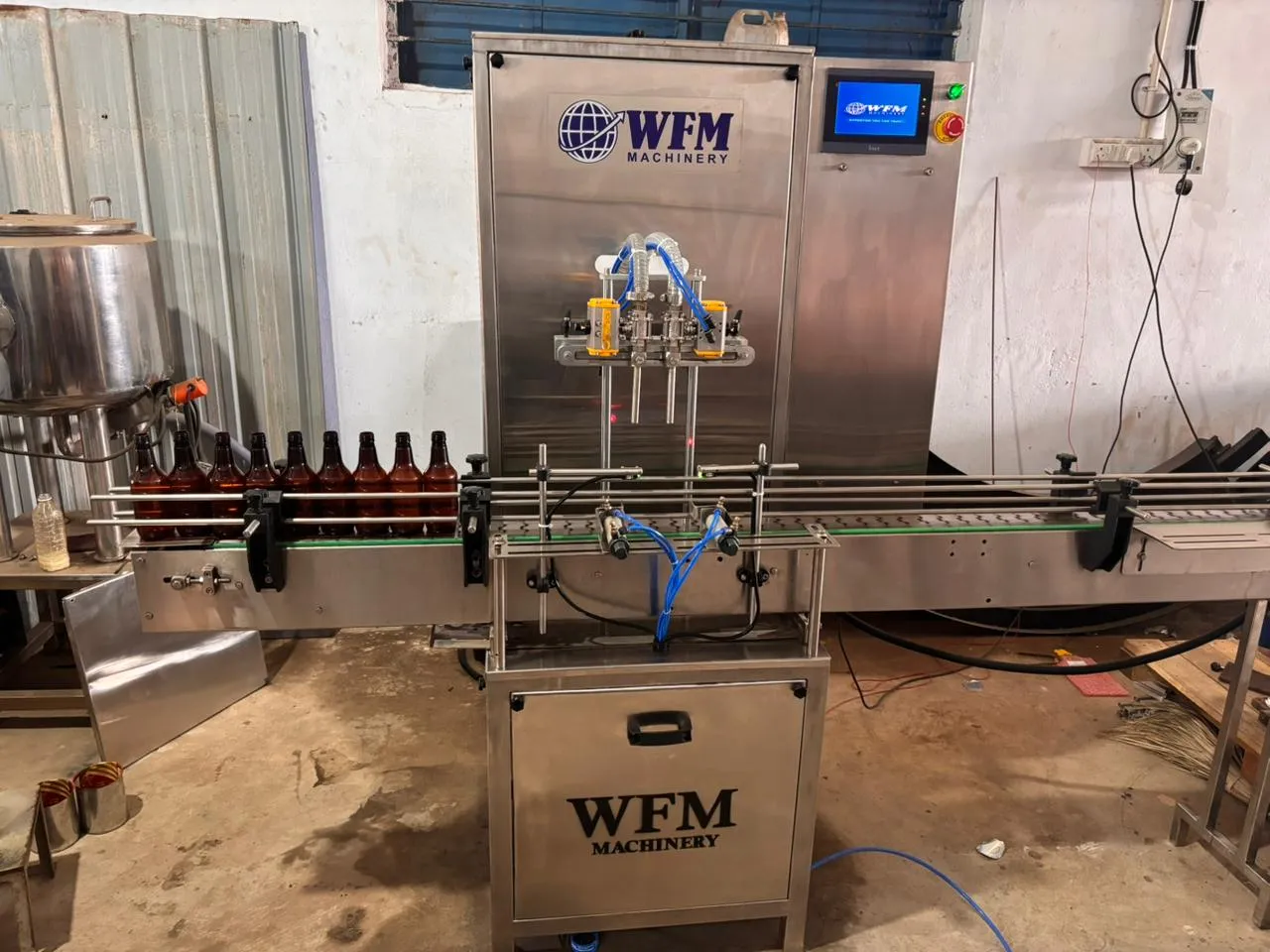
The Hidden Enemy: Micro Overfilling
Most filling losses do not look dramatic.
They look like this:
- 0.8 ml extra in each bottle
- 1.2 ml safety overfill
- Slight volume drift after 3 hours of running
Individually insignificant.
But multiply that across 10,000–30,000 bottles per day, and the annual loss becomes serious.
For example:
1 ml extra × 20,000 bottles per day = 20 liters daily
20 liters × 300 days = 6,000 liters per year
Now multiply that by your product cost per liter.
That is not waste you see on the floor.
That is margin quietly disappearing.
Why Inaccuracy Happens in Real Plants
Before solving wastage, understand why it happens.
Common causes:
- Manual volume adjustment
- Air pressure fluctuation in pneumatic systems
- Mechanical wear of pistons and seals
- Viscosity variation between batches
- Foam disturbing fill level
- Operator “safety buffer” overfill
If your team frequently adjusts fill settings, you are already losing control.
How Accurate Filling Machines Stop Product Giveaway
Accurate filling systems reduce wastage through control, not speed.
Here is how.
1. Digital Volume Control
Instead of mechanical stroke setting, modern machines allow digital input of exact fill volume.
Once set, the system repeats that volume consistently.
Buyer benefit:
- No drift during long production runs
- No need for constant recalibration
- Reduced overfill buffer
Result: Controlled and predictable output.
2. Servo-Controlled Precision
Servo-based systems control motion electronically instead of relying on air pressure.
This eliminates:
- Stroke variation
- Pressure instability
- Manual dependency
Buyer benefit:
- High repeatability
- Stable accuracy even after hours of operation
- Lower product deviation
Result: Less cumulative wastage.
3. Real-Time Flow Monitoring
Advanced systems measure actual liquid flow and stop filling at the programmed value.
Buyer benefit:
- Automatic correction
- Reduced human error
- High accuracy in thin liquid applications
Result: Minimal product giveaway in high-volume production.
4. Controlled Filling Speed
Uncontrolled speed causes splashing and foam, which affects final volume.
Accurate systems allow:
- Programmable acceleration
- Bottom-up filling
- Controlled deceleration
Buyer benefit:
- Stable fill level
- Faster settling time
- Reduced underfill or overfill correction
Result: Cleaner, more efficient production.
Accuracy Protects Both Sides: Overfill and Underfill
Buyers often worry about underfilling penalties.
But constantly overfilling to avoid underfill is financially dangerous.
Accurate machines allow:
- Compliance without excessive giveaway
- Tight tolerance within legal limits
- Confidence without margin loss
Accuracy gives balance.
Where Accuracy Matters Most
You should prioritize filling precision if:
- Your product cost per liter is high
- Your daily output is large
- Your margins are tight
- You operate in regulated industries
- You experience frequent recalibration
- You handle multiple SKUs
In these cases, even small improvements in accuracy create measurable annual savings.
Comparing Basic vs High-Accuracy Systems
| Factor | Basic System | High-Accuracy System |
|---|---|---|
| Fill Variation | Moderate | Minimal |
| Product Giveaway | Frequent | Controlled |
| Operator Dependency | High | Reduced |
| Recalibration | Frequent | Rare |
| Margin Protection | Weak | Strong |
| Long-Term Cost Control | Limited | Improved |
The difference is not visible in one shift.
It becomes visible over one year.
The ROI Question Buyers Should Ask
Before buying, calculate:
- Average overfill per bottle
- Daily production volume
- Product cost per unit
- Annual operating days
That number tells you how much inaccuracy is costing you today.
Often, buyers discover that improved accuracy alone can justify machine investment within a reasonable timeframe.
Frequently Asked Questions
Does better accuracy reduce speed?
No. Modern systems maintain speed while improving control.
Is accurate filling only important for large factories?
No. Even mid-scale operations lose significant margin if output is consistent.
Will accurate machines eliminate wastage completely?
No system eliminates loss entirely, but precise machines drastically reduce avoidable variation.
Is upgrading expensive?
Initial cost may be higher, but long-term savings from reduced giveaway often justify the investment.
Final Buyer Insight
Most filling losses are invisible.
They do not show up as broken bottles.
They show up as thinner margins.
An accurate filling machine is not just a piece of equipment.
It is a margin stabilization system.
Before finalizing your purchase, evaluate:
Your current overfill percentage
Your annual production volume
Your product value
Your acceptable tolerance
Your future growth plan
When filling accuracy improves, profitability stabilizes.
If you share your product type and daily output, the potential savings from improved precision can be estimated more clearly — helping you make a financially smarter decision.