
If you are planning to invest in a cosmetic liquid filling machine, this decision will directly affect your product consistency, brand perception, production efficiency, raw material cost, customer satisfaction, and long-term profitability.
Cosmetic products are not simple liquids. They are value-added formulations where texture, density, smoothness, and visual appearance matter. A poor filling decision can damage not only margins but also brand reputation.
This guide covers every critical point you must evaluate before investing, so you do not make an expensive mistake.
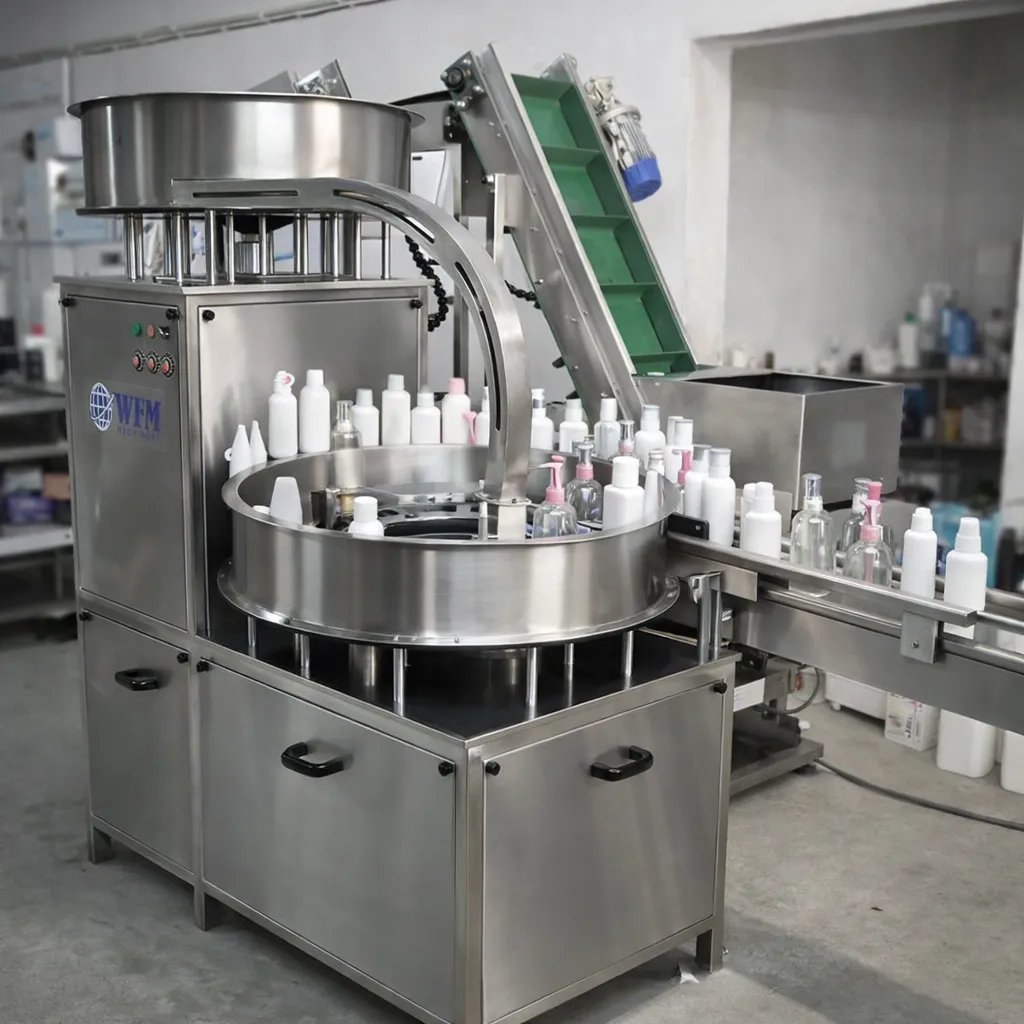
Step 1: Understand Your Product Before Looking at Machines
The biggest buyer mistake is choosing a machine before understanding product behavior.
Cosmetic liquids vary widely:
- Very thin (toners, micellar water, perfume base)
- Medium viscosity (shampoo, lotion, body wash)
- Thick (cream, gel, conditioner)
- Semi-solid (face masks, scrubs)
- Shear-sensitive (serums, emulsions)
- Particle-containing (scrubs, exfoliants)
You must clearly define:
- Viscosity range
- Whether viscosity changes with temperature
- Whether the product foams during filling
- Whether the formulation is shear-sensitive
- Whether it contains particles
- Whether it is hot-filled or filled at room temperature
The filling technology must match product behavior. Otherwise, you risk separation, air entrapment, inconsistent fill, or leakage.
Step 2: Choose the Right Filling Technology
There is no single “best” machine. The best machine matches your formulation.
Piston Filling Machines
Best for:
- Medium to high viscosity
- Creams, gels, lotions
- Particle-containing products
Advantages:
- Strong volumetric control
- Handles thick products consistently
- Less sensitive to minor viscosity changes
Risk if chosen incorrectly:
- Overfilling thin liquids
- Mechanical wear if poorly maintained
Servo-Controlled Piston Fillers
Best for:
- Accuracy-critical production
- Multiple SKUs
- Premium cosmetic brands
Advantages:
- Digital stroke control
- Minimal fill variation
- Repeatable precision
- Easy volume changeover
Higher initial investment but better long-term control.
Peristaltic Pump Fillers
Best for:
- High-value serums
- Sterile or contamination-sensitive products
- Small-volume precision filling
Advantages:
- No internal mechanical product contact
- Gentle filling
- Very precise small-dose capability
Usually slower but extremely accurate.
Flow Meter Filling Machines
Best for:
- Low to medium viscosity liquids
- Oil-based cosmetic liquids
- Watery formulations
Advantages:
- Electronic volume measurement
- High speed capability
- Digital adjustments
Less suitable for thick creams.
Step 3: Accuracy Is Margin Protection
Cosmetic products often have high formulation cost.
Even 1 ml overfill per bottle can significantly reduce profit across large production runs.
Before buying, ask:
- What is the guaranteed fill tolerance?
- Does accuracy remain stable during long shifts?
- Does accuracy change with viscosity variation?
- How often is recalibration required?
High accuracy reduces:
- Raw material loss
- Rework
- Customer complaints
- Brand inconsistency
Low-cost machines often drift during extended operation.
Step 4: Speed vs Stability
Manufacturers often advertise high bottles per minute.
Important questions:
- Is that speed achievable with your viscosity?
- Does accuracy remain stable at maximum speed?
- Does foam increase at higher speed?
- Will product texture be affected?
For cosmetics, stability is often more important than extreme speed.
Choose a machine that maintains precision at your required output rather than focusing only on maximum speed claims.
Step 5: Container Compatibility
Cosmetic packaging is diverse:
- Pump bottles
- Flip-top bottles
- Glass serum bottles
- Airless containers
- Jars
- Tubes
Your filling machine must support:
- Adjustable height and diameter
- Nozzle diving for narrow containers
- Stable bottle centering
- Quick format changeover
- Compatibility with different neck types
Without flexibility, future product launches become difficult.
Step 6: Changeover Time
Cosmetic brands often manage multiple SKUs.
Without fast changeover features, you lose valuable production hours.
Look for:
- Digital volume adjustment
- Recipe storage for multiple products
- Tool-less nozzle adjustment
- Adjustable bottle guides
- Quick cleaning design
Faster changeovers increase total monthly output.
Step 7: Hygiene and Cleanability
Cosmetic formulations require hygienic handling to prevent contamination and spoilage.
Essential features:
- Stainless steel product contact parts
- Smooth internal flow paths
- Minimal dead zones
- Easy nozzle removal
- Optional cleaning-in-place capability if required
Difficult cleaning increases downtime and contamination risk.
Step 8: Foam and Splash Control
Products such as shampoo and body wash may foam during filling.
Without control, this leads to:
- Inconsistent fill levels
- Spillage
- Slower production
Look for:
- Adjustable filling speed
- Bottom-up filling capability
- Controlled acceleration
- Anti-drip nozzles
Foam control improves both accuracy and efficiency.
Step 9: Automation Level
Semi-Automatic Machines:
- Lower initial investment
- Manual bottle placement
- Suitable for lower production volumes
Automatic Machines:
- Conveyor-based movement
- Reduced operator dependency
- Higher consistency
- Better scalability
Choose based on production volume, labor cost, and growth plans.
Step 10: Integration With Full Packaging Line
A filling machine should integrate with:
- Bottle feeding systems
- Capping machines
- Pump insertion systems
- Labeling machines
- Coding systems
Poor integration creates bottlenecks and increases downtime.
Step 11: Control System and Interface
A modern cosmetic filling machine should provide:
- Digital touch interface
- Volume setting through control panel
- Error display and diagnostics
- Recipe memory
- Production tracking capability
This reduces operator dependency and increases consistency.
Step 12: Maintenance and Spare Parts
Before purchasing, ask:
- What components wear out most frequently?
- How often are seals replaced?
- Are spare parts easily available?
- Is technical support accessible?
A machine without proper support can stop production completely.
Step 13: Total Cost of Ownership
Do not compare machines only by purchase price.
Compare:
- Fill accuracy
- Product wastage reduction
- Downtime reduction
- Labor savings
- Maintenance cost
- Expansion flexibility
A lower-priced machine may cost more over time due to inefficiency and wastage.
Frequently Asked Questions
Which machine is best for cosmetic creams?
Servo-controlled piston fillers typically provide stable and accurate filling for medium to high viscosity creams.
Can one machine handle lotion and serum both?
Yes, if the system supports a wide viscosity range and flexible volume adjustment.
Is automation necessary for small cosmetic brands?
Not mandatory, but automation improves consistency and scalability as production increases.
Does higher speed reduce accuracy?
Poorly designed systems may lose accuracy at high speed, but quality machines maintain precision within rated capacity.
How do I calculate ROI?
Estimate savings from reduced product wastage, lower labor cost, and improved throughput over one year.
What is the biggest mistake buyers make?
Selecting a machine based only on price instead of matching it to product behavior and long-term cost control.
Final Buyer Perspective
A cosmetic liquid filling machine influences product quality, brand reputation, operational efficiency, and profitability.
Before investing, evaluate:
- Your product range
- Viscosity behavior
- Packaging diversity
- Daily production volume
- Changeover frequency
- Growth plans
When the machine matches your formulation and business objectives, it becomes a long-term operational asset rather than a recurring problem.
If you share your product types and target output, a more precise configuration recommendation can be structured based on your specific requirements.