
A Complete, Practical Guide for Liquid Manufacturers by WFM Machinery
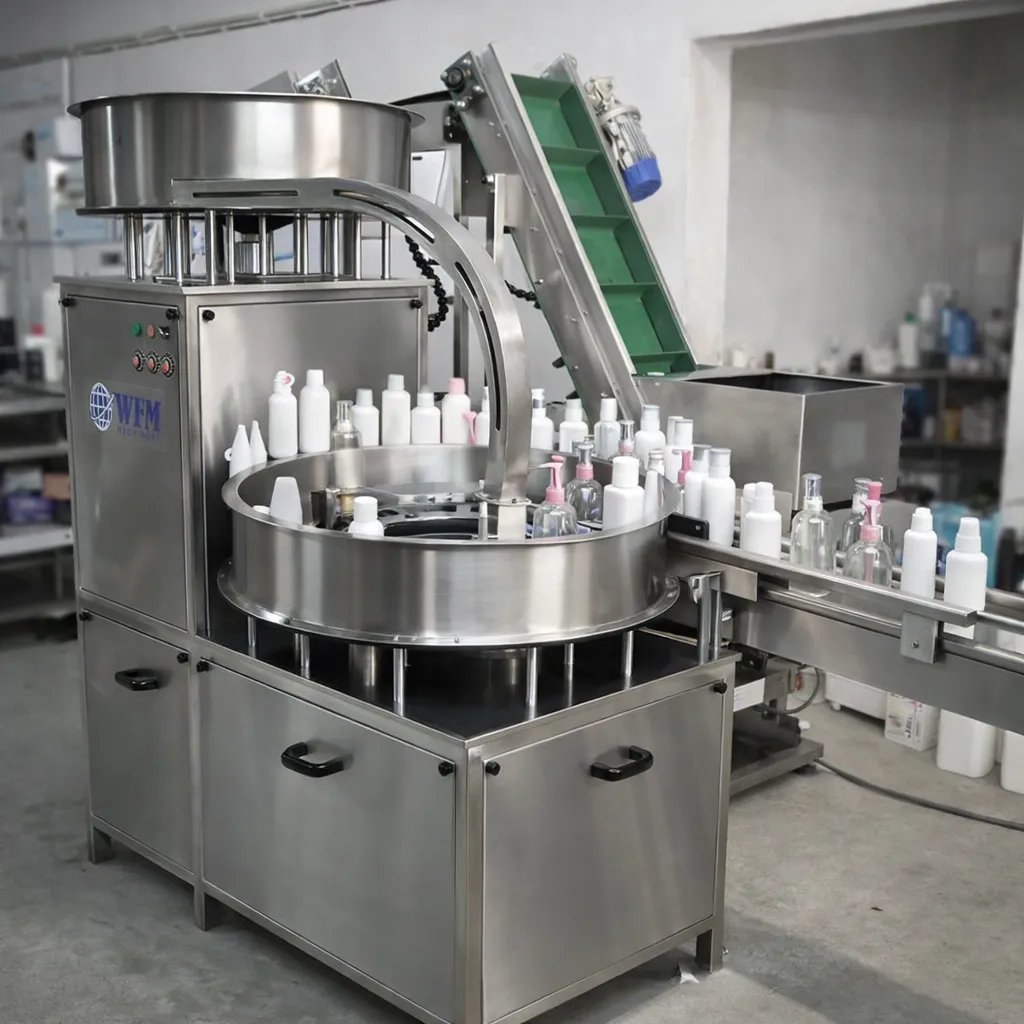
Liquid filling looks simple from the outside. A bottle moves in, liquid goes in, bottle moves out.
In real production environments, however, filling is one of the most sensitive and loss-prone stages in the entire packaging line.
Small variations create product wastage.
Minor misalignment causes spillage.
Manual adjustments slow down production.
Foaming delays capping.
Inconsistent fills damage brand trust.
Over time, these “small” issues turn into major financial losses.
This guide explains the most common filling problems manufacturers face — and how automation directly solves them in measurable ways.
Why Filling Problems Become Expensive
Many manufacturers underestimate filling inefficiencies because they do not immediately appear serious.
Consider this:
- 1 ml overfill × 25,000 bottles per day
- 20 minutes downtime per shift
- 2% rejection due to variation
- 3 operators constantly adjusting machine settings
Now multiply that across 300 production days per year.
Filling problems are rarely dramatic. They are cumulative.
Automation does not just increase speed. It increases control, consistency, and predictability.
Most Common Filling Problems in Production
Below are the real issues that impact profitability.
1. Overfilling and Product Giveaway
The Problem
Overfilling happens when the machine dispenses more than the declared volume. Many operators intentionally allow slight overfill to avoid underfill complaints.
This feels safe — but it quietly reduces margins.
Why It Happens
- Manual volume adjustment
- Air pressure fluctuation
- Stroke inconsistency
- Operator error
- Viscosity variation
How Automation Solves It
Automated systems provide:
- Servo-controlled volumetric precision
- Real-time flow monitoring
- PLC-based repeatability
- Stored volume recipes
Once programmed, fill volume remains stable throughout production.
Result: Reduced product wastage and protected margins.
2. Underfilling and Compliance Risk
The Problem
Underfilling can lead to:
- Legal penalties
- Customer complaints
- Product recalls
- Brand damage
Why It Happens
- Mechanical wear
- Poor calibration
- Inconsistent liquid supply
- Improper manual setup
Automation Solution
Automation enables:
- Precise volumetric control
- Consistent repeat cycles
- Integration with checkweighers
- Automatic rejection systems
Result: Regulatory compliance and reduced risk exposure.
3. Inconsistent Fill Levels in Transparent Bottles
The Problem
Even if volume is technically correct, visible variation in fill height creates negative customer perception.
Common in:
- Edible oil
- Juice
- Water
- Cosmetic serums
Why It Happens
- Foam formation
- Bottle dimension variation
- Nozzle positioning inconsistency
Automation Solution
Automated machines offer:
- Controlled filling speed
- Bottom-up filling
- Level-based filling systems
- Precise nozzle diving
Result: Uniform appearance and stronger brand image.
4. Foaming During Filling
The Problem
Foaming slows production and reduces accuracy.
Common in:
- Shampoos
- Detergents
- Beverages
- Certain chemicals
Why It Happens
- High-speed uncontrolled filling
- Excess drop height
- Incorrect nozzle design
Automation Solution
Automation allows:
- Controlled acceleration and deceleration
- Programmable fill profiles
- Anti-foam filling techniques
- Bottom-up nozzle movement
Result: Faster production with stable fill accuracy.
5. Bottle Misalignment and Spillage
The Problem
Misaligned bottles cause:
- Product spillage
- Contamination
- Cleaning downtime
- Material loss
Why It Happens
- Manual placement
- Worn guides
- Conveyor instability
- Inconsistent bottle shapes
Automation Solution
Automated lines use:
- Sensor-based bottle detection
- Pneumatic stoppers
- Servo indexing systems
- Synchronized conveyors
Result: Accurate positioning and reduced product loss.
6. Frequent Manual Adjustments
The Problem
Operators constantly adjust:
- Stroke length
- Air pressure
- Fill timing
This increases error risk and slows production.
Automation Solution
Modern systems provide:
- Digital HMI volume input
- Recipe storage
- One-touch adjustments
- Minimal operator intervention
Result: Faster setup and consistent output.
7. Viscosity Variation Between Batches
The Problem
Products like syrup, gel, sauce, and cream often vary slightly in viscosity.
Manual systems struggle to maintain consistent output when viscosity changes.
Automation Solution
Servo-driven systems maintain controlled volumetric displacement even when viscosity shifts slightly.
Result: Stable fill performance across batches.
8. Slow Changeover Between SKUs
The Problem
Manufacturers handling multiple SKUs lose time adjusting:
- Bottle guides
- Volume settings
- Nozzle positions
Automation Solution
Automated filling lines allow:
- Recipe recall
- Tool-less guide adjustment
- Digital volume control
- Faster format switching
Result: Reduced downtime and increased daily output.
9. Cleaning and Hygiene Challenges
The Problem
Poor cleaning increases contamination risk, especially in:
- Pharmaceuticals
- Food production
- Cosmetics
Manual dismantling increases downtime.
Automation Solution
Advanced systems offer:
- Clean-in-Place capability
- Hygienic stainless steel construction
- Smooth internal flow paths
- Reduced dead zones
Result: Faster cleaning and improved compliance.
Problem vs Automation Impact Summary
| Common Problem | Business Impact | Automation Benefit |
|---|---|---|
| Overfilling | Product loss | Precise volumetric control |
| Underfilling | Legal & brand risk | Consistent dosing & inspection |
| Foaming | Slower cycle time | Controlled fill speed |
| Misalignment | Spillage & downtime | Sensor-based positioning |
| SKU changeover delay | Lost production hours | Recipe-based adjustments |
| Manual errors | Inconsistent output | Reduced operator dependency |
| Hygiene issues | Compliance risk | CIP & hygienic design |
Financial Impact of Automation
Automation reduces:
- Product giveaway
- Labor dependency
- Downtime
- Rejection rates
- Compliance risks
Automation improves:
- Production consistency
- Bottles per minute output
- Brand reliability
- Long-term scalability
- Overall profitability
When Should You Consider Automation?
Automation becomes essential if:
- Daily production is high
- Multiple SKUs are handled
- Labor cost is increasing
- Compliance standards are strict
- Product value per unit is high
- Expansion is planned
For very small, stable operations, semi-automation may still be practical.
For scaling businesses, automation becomes a financial advantage rather than a luxury.
Frequently Asked Questions
Is automation only about increasing speed?
No, automation primarily improves accuracy, consistency, and cost control.
Does automation completely eliminate manpower?
No, but it reduces operator dependency and human error significantly.
Is automation expensive?
Initial investment is higher, but long-term savings from reduced wastage and downtime often justify it.
Can automation handle thick products?
Yes, especially when servo-controlled systems are used.
Will automation reduce rejection rates?
Yes, consistent filling and integrated inspection systems reduce rejection significantly.
Final Buyer Perspective
Most filling problems are not dramatic machine failures.
They are small inefficiencies repeated thousands of times per day.
Automation does not simply make your line faster.
It makes it predictable, stable, and financially optimized.
Before deciding, evaluate:
- Your daily production volume
- Your current rejection rate
- Your product wastage percentage
- Your labor cost
- Your SKU variation
- Your growth projection
If filling-related losses are affecting profitability, automation is not an upgrade — it is a strategic correction.
If you share your product type and production scale, a clearer automation recommendation can be structured based on your specific challenges.