
If you are already manufacturing phenyl, you know that production is not the main challenge. The real bottleneck in most units is the filling process.
Many manufacturers start with manual or basic setups. Initially, this works. But as demand increases, it begins to create serious issues—affecting output, consistency, and profitability.
This guide from WFM Machinery will addresses real challenges faced by phenyl manufacturers and helps you select the right filling machine configuration based on actual market conditions.
The Real Problem in Phenyl Manufacturing
Most manufacturers face issues like:
- Slow filling speed
- Inconsistent bottle volumes
- Product wastage
- High labor dependency
- Inability to scale production
These problems limit growth even when demand is strong.
Why Manual or Incorrect Machines Fail
Phenyl is:
- Slightly thick
- Emulsion-based
- Foam-sensitive
Because of this, using manual filling or water-type machines leads to:
- Inaccurate filling
- Spillage and dripping
- Poor product presentation
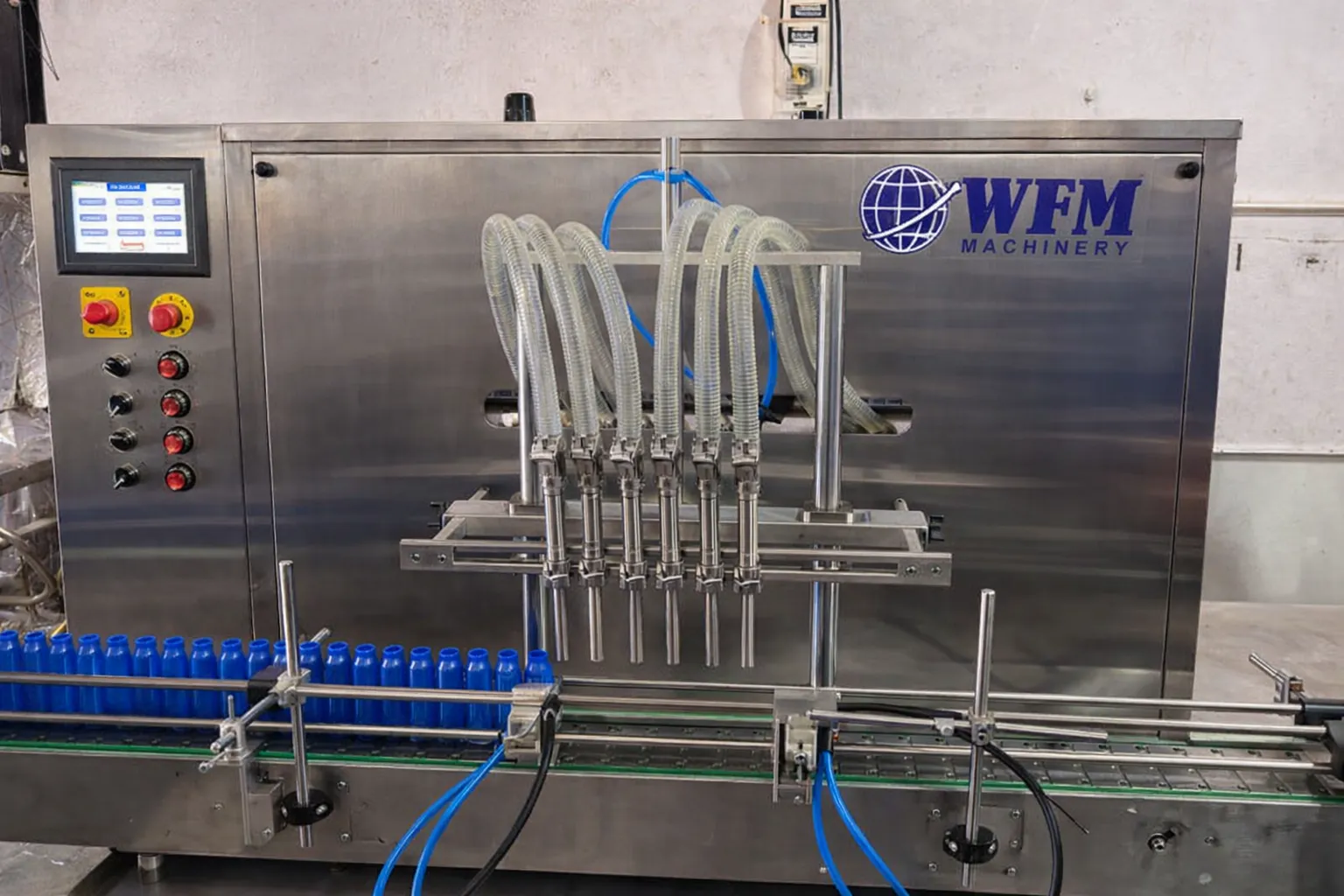
The Right Solution: Viscous Liquid Filling Machine (Piston Type)
For phenyl, the correct solution is a piston-type viscous liquid filling machine.
This machine ensures:
- Accurate and repeatable filling
- Controlled flow for thick liquids
- No dripping or wastage
- Professional packaging output
Machine Configuration Comparison (2 Head vs 4 Head vs 6 Head vs 8 Head)
Below is a practical comparison based on real industry usage in India.
| Configuration | Machine Type | Speed Range | Output/Hour | Best For | Investment Range |
|---|---|---|---|---|---|
| 2 Head | Semi / Entry Auto | 10–20 BPM | 600 – 1000 bottles | Small manufacturers / manual upgrade | ₹50,000 – ₹2,00,000 |
| 4 Head | Automatic | 30–60 BPM | 1000 – 1800 bottles | Growing businesses | ₹2,50,000 – ₹5,00,000 |
| 6 Head | Automatic | 60–100 BPM | 1800 – 3000 bottles | Distributor-level production | ₹4,00,000 – ₹7,00,000 |
| 8 Head | High-Speed Automatic | 80–140 BPM | 2400 – 4000+ bottles | Large-scale / institutional supply | ₹6,00,000+ |
Note: Output depends on bottle size (500ml–1L), liquid consistency, and machine quality.
How to Choose the Right Machine
- If you are currently doing manual filling → choose 2 head semi-automatic
- If you have stable demand → choose 4 head automatic
- If you supply to distributors → choose 6 head machine
- If you are targeting bulk contracts → choose 8 head automatic
The goal is to match your machine with your actual production needs.
Production and ROI Perspective
Most manufacturers focus only on machine cost, but the real issue is operational loss.
Losses occur due to:
- Underfilling or overfilling
- Product wastage
- Slow production
- Missed delivery timelines
A proper filling machine improves:
- Production speed
- Filling accuracy
- Labor efficiency
This leads to better output and faster recovery of investment.
Multi-Product Capability
A piston-type viscous liquid filling machine is not limited to phenyl.
It can also be used for:
- Floor cleaners
- Toilet cleaners
- Liquid detergents
- Disinfectant liquids
This allows manufacturers to expand product range without investing in separate machines.
Common Buyer Questions
Which machine is best for phenyl?
A piston-type viscous liquid filling machine is the correct choice.
How many heads should I choose?
It depends on your production requirement. 2, 4, 6, or 8 head machines are selected based on output needs.
Can I start small and upgrade later?
Yes. Many manufacturers begin with smaller configurations and upgrade as demand increases.
Does increasing head count affect accuracy?
No. Accuracy depends on machine design. Head count increases speed.
What maintenance is required?
Routine cleaning and basic servicing are sufficient for smooth operation.
Why Manufacturers Choose WFM Machinery
WFM Machinery focuses on providing practical solutions for viscous liquid filling applications like phenyl.
- Machines designed for real production conditions
- Consistent and accurate filling performance
- Multiple configurations based on capacity
- Guidance based on actual manufacturing requirements
Manufacturers working with WFM Machinery are able to improve production efficiency and scale operations confidently.
Final Perspective
If your current filling process is limiting your production, the issue is not your product but your system.
Choosing the correct machine configuration—2 head, 4 head, 6 head, or 8 head—directly impacts your output, consistency, and profitability.
Take the Next Step
If you are planning to increase production or facing limitations in your current setup, the next step is to select the right machine based on your capacity and business goals.
WFM Machinery provides precise recommendations tailored to your requirement.
Share your current production details and get the most suitable filling machine solution for your phenyl manufacturing business.