
If you are investing in a liquid filling machine, you are not simply purchasing equipment. You are deciding how accurate your fills will be, how efficient your production line will run, how much product you may unknowingly give away, and how scalable your operation will remain over the next decade.
The real question is not which technology sounds more advanced.
The real question is: Which system will improve your profitability and support your growth?
At WFM Machinery, most buyers initially focus on price difference. But once we evaluate their product value, daily output, and expansion plan, the decision becomes clearer and more strategic.
Understanding the Core Difference
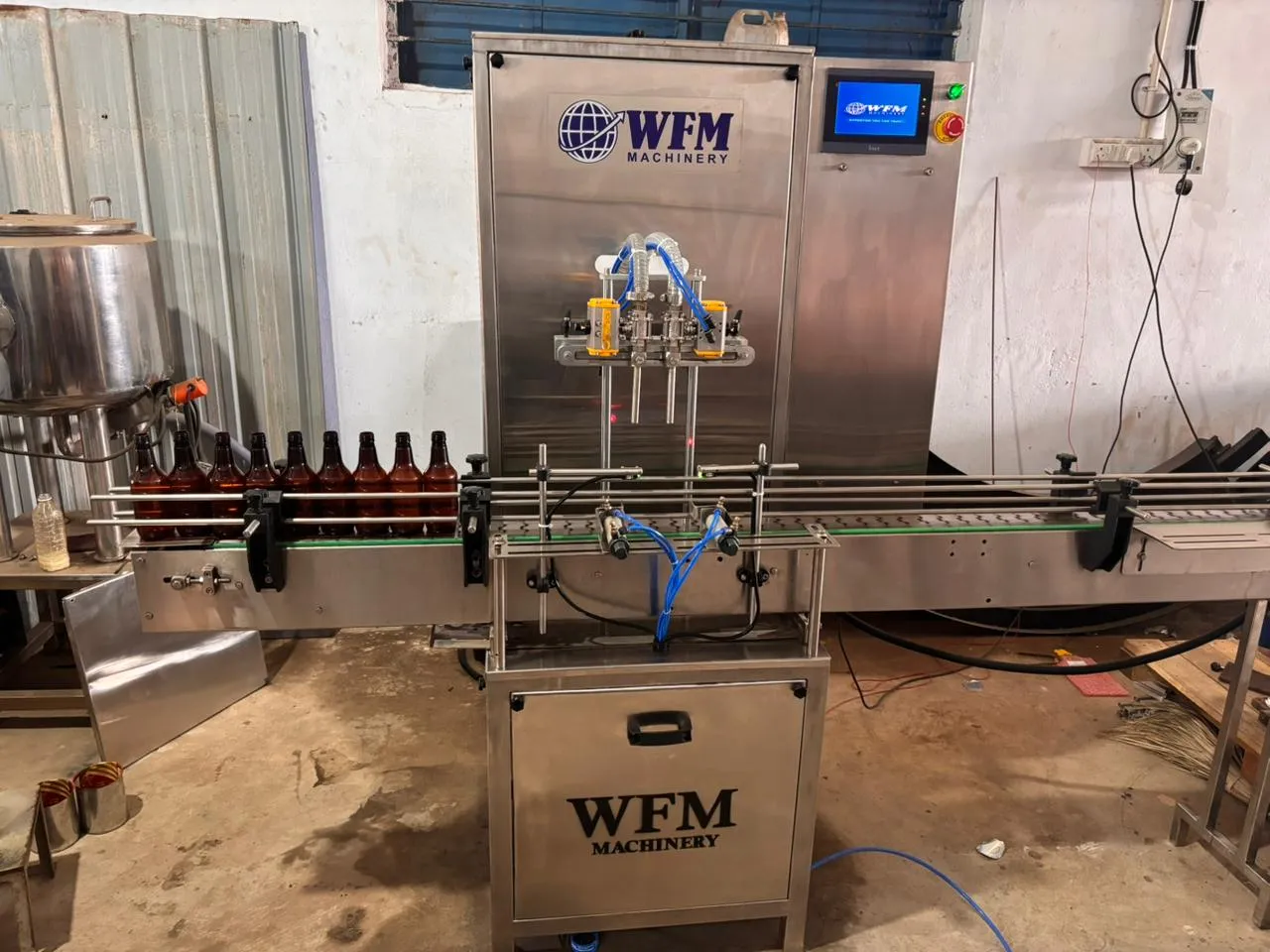
A pneumatic filling machine operates using compressed air to move pistons or cylinders. Volume is controlled mechanically through stroke adjustments and air pressure settings. It is simple, proven, and widely used in standard applications.
A servo based filling machine uses digitally controlled servo motors. Every movement is programmed through PLC systems. Stroke position, speed, acceleration, and volume are electronically controlled and repeatable.
In simple terms, pneumatic systems rely on air-driven mechanical force. Servo systems rely on digital precision.
Where Profit Is Actually Lost
Consider this practical example.
If you overfill just 1–2 ml in each bottle of syrup, edible oil, or cosmetic lotion, it may not seem significant.
Now multiply that small variation across thousands of bottles per day, month after month. That difference becomes measurable financial loss.
Servo based systems provide highly consistent volumetric control. Because motor positioning is digitally monitored, repeatability remains stable across long production cycles. For high-value liquids, this precision protects your margins.
Pneumatic systems deliver reliable performance, but fill consistency can vary slightly depending on air pressure stability and seal condition. For lower-cost products, this may be acceptable. For premium or regulated products, even small variation matters.
At WFM Machinery, we often calculate the annual cost of product giveaway before recommending a technology. In many cases, improved accuracy offsets the initial investment difference.
Planning for Growth Instead of Today’s Volume
Your current production may be moderate, but what about three years from now?
Servo based systems allow recipe-based adjustments directly from the HMI. You can store multiple volume settings and switch between SKUs quickly. Smooth acceleration and deceleration reduce foaming and splashing, supporting higher speeds when needed.
Pneumatic systems require manual mechanical adjustments during changeovers. For single-product operations, this may not be an issue. For multi-SKU production environments, downtime increases.
Many expanding manufacturers working with WFM Machinery choose servo technology to avoid replacing their filling system when production scales.
Looking Beyond Purchase Price
Initial cost is only one part of the decision.
You should evaluate:
Energy consumption
Maintenance requirements
Compressed air system cost
Downtime during SKU changeovers
Product wastage due to fill variation
Future automation compatibility
Pneumatic systems generally have lower upfront investment.
Servo systems often deliver stronger long-term return in high-volume or high-accuracy environments.
The correct decision depends on your production model, not just your budget.
Matching Technology to Your Situation
A pneumatic filling machine may be suitable if:
Your production volume is moderate
Your product tolerance requirements are standard
Your capital investment must remain controlled
You operate limited SKUs
A servo based filling machine is typically more suitable if:
Your product value is high
Accuracy directly impacts profitability
You manage multiple SKUs
You plan to automate your packaging line
You expect significant production growth
When buyers consult WFM Machinery, we do not recommend technology based on trend or complexity. We align the system with product characteristics, daily output targets, and future expansion plans.
Avoiding the Wrong Investment
Under-investing may lead to early replacement when your production grows.
Over-investing may increase financial pressure if your current demand does not justify advanced technology.
The smart buyer evaluates both current needs and realistic growth projections.
At WFM Machinery, our approach is data-driven. We assess viscosity, bottle size, fill volume, daily output, and acceptable tolerance before advising the right system.
Final Perspective for Serious Buyers
If your priority is low capital investment and simple operation, pneumatic technology remains practical and dependable.
If your priority is precision, scalability, reduced wastage, automation readiness, and long-term operational efficiency, servo based filling technology offers stronger strategic value.
The best machine is not the cheapest option.
The best machine is the one that supports your growth without limiting your performance.
If you share your product type, viscosity range, bottle size, and daily production target, the engineering team at WFM Machinery can provide a practical recommendation tailored specifically to your operation.