
High-speed bottling lines are the backbone of beverage production in India — whether you’re packaging mineral water, juices, soft drinks, energy drinks, or other liquid beverages. At the heart of every efficient bottling plant is the bottle feeding system that ensures uninterrupted flow of containers into the filling process.
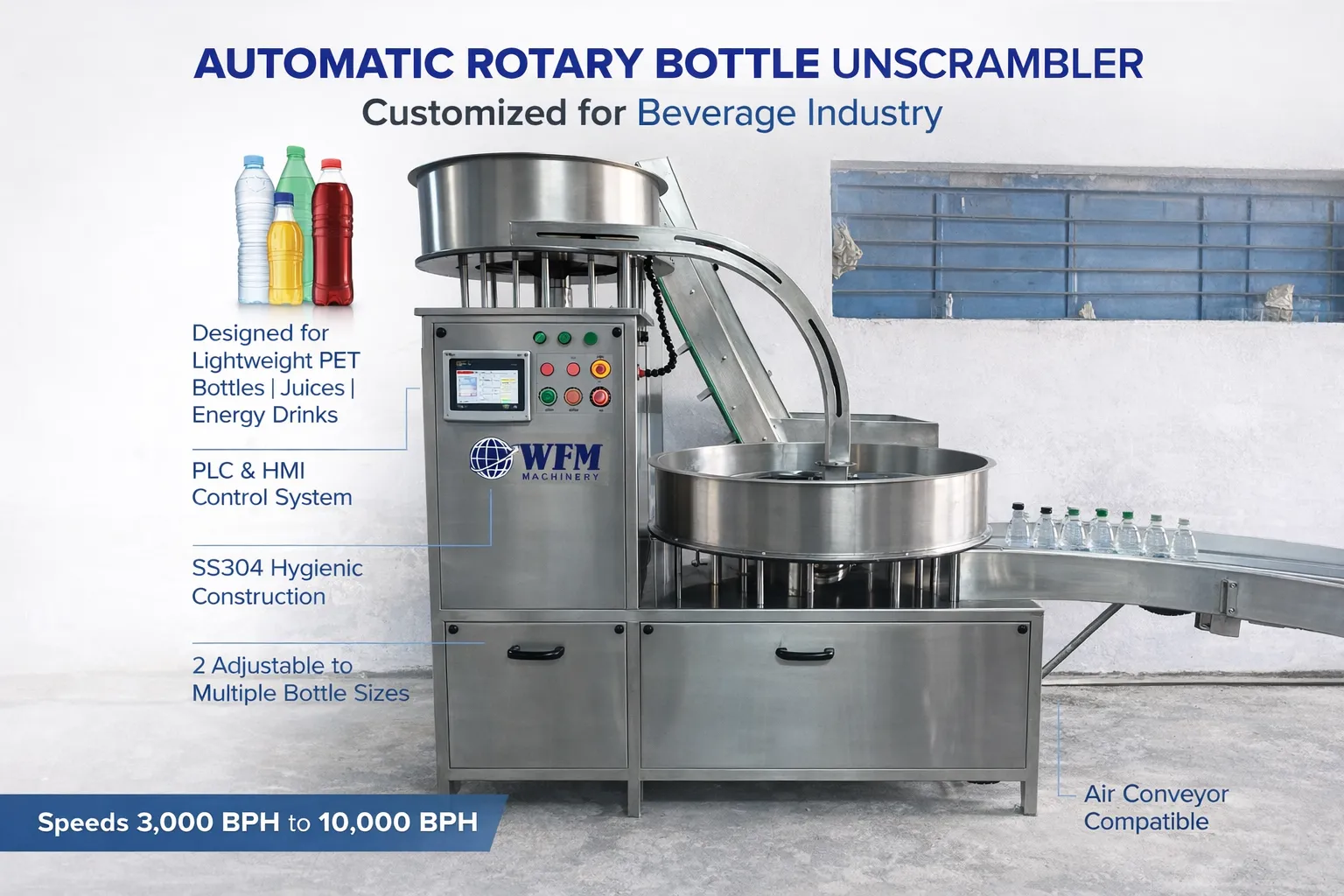
An automatic bottle unscrambler transforms random empty bottles into a smooth, correctly oriented, single-file stream that feeds your filling machine reliably at high speeds. For producers operating above 3000 BPH and up to 10000 BPH, choosing the right automatic rotary bottle unscrambler is one of the most impactful decisions for production efficiency and cost optimization.
At WFM Machinery, we design and supply industry-grade automatic rotary bottle unscramblers that deliver sustained performance, minimal downtime, and measurable return on investment. This comprehensive guide explains how these systems work, why they matter, and how to choose the right solution for beverage plants in India.
The Bottleneck That Many Beverage Plants Overlook
The typical bottling line includes:
-
Bottle feeding and orientation
-
Filling and dosing
-
Capping and sealing
-
Labeling and packaging
-
Conveyors and accumulation systems
When the bottle feeding stage fails to supply bottles consistently, even the best filling machines cannot run at full capacity. Common issues in manual or low-capacity feeding systems include:
-
Irregular bottle orientation
-
Frequent filler stoppages
-
Conveyor jams
-
Labor dependency
-
Bottle damage from mishandling
-
Increased downtime
These issues directly translate into lost production time, higher operating costs, and lower overall equipment effectiveness (OEE).
Why a High-Performance Unscrambler Is Essential
An automatic rotary bottle unscrambler handles large volumes with precision by:
Accepting bulk loaded bottles — Bottles enter the hopper in random orientation.
Using centrifugal motion — A rotary disc spreads bottles outward uniformly.
Separating upright bottles — Only correctly oriented bottles proceed.
Recycling misoriented bottles — Incorrect bottles are re-circulated automatically.
Discharging in a single file — Bottles flow smoothly to the filler.
Synchronizing with the line — PLC and sensor control manage speed and alarms.
This automation eliminates manual bottle feeding, stabilizes production flow, and supports high-speed bottling operations.
Core Benefits for Beverage Manufacturers
Beverage producers in India gain multiple operational advantages from installing an automatic bottle unscrambler:
Improved line efficiency — Bottles feed reliably at rated speed, reducing filler stoppages.
Consistent production output — Higher effective BPH without labor limits.
Reduced manual labor — Fewer operators are needed for bottle loading.
Lower bottle damage — Controlled handling reduces breakage and rejects.
Enhanced hygiene — Minimal human contact reduces contamination risk.
Higher OEE — Stable throughput maximizes plant performance.
These benefits are not simply incremental — they have a measurable impact on operating cost and throughput capacity.
How Automatic Rotary Bottle Unscramblers Work
At its core, an automatic rotary unscrambler operates on controlled centrifugal motion, intelligent orientation channels, and electronic synchronization.
Bulk Loading:
Empty bottles are loaded into a hopper or elevator subsystem. At this stage, bottle orientation is random.
Rotary Distribution:
The rotating disc, driven by a variable speed motor, creates centrifugal force that evenly spreads the bottles toward the perimeter of the system.
Orientation Channels:
Custom-designed guide rails and pockets allow only upright bottles to proceed toward the discharge path. Misaligned bottles are recirculated automatically for another pass.
Controlled Discharge:
Once oriented, bottles move into a single-file discharge conveyor. Sensors and PLC logic ensure discharge speed matches the filling line’s needs, preventing pile-ups or gaps.
Automation Control:
PLC and HMI interfaces allow operators to adjust speeds, set recipes for multiple bottle formats, and monitor system health in real time.
This cohesive working principle enables continuous operation at high throughput levels.
Key Selection Criteria for Beverage Plants in India
Choosing the right automatic bottle unscrambler requires careful evaluation of multiple factors:
Line Speed (BPH)
Determine the exact capacity of your filling line. Unscramblers must match or slightly exceed the maximum filler speed to avoid choke points. While small plants may operate at 2000–3000 BPH, many modern beverage lines run at 5000 BPH and above. High-performance machines are engineered for sustained operation at 6000–10000 BPH.
Bottle Specifications
Precise bottle dimensions and material details are essential:
Material type — PET, HDPE, etc.
Height range — Minimum and maximum bottle height
Diameter range — Neck size and body diameter
Weight — Lightweight bottles require careful handling
Shape — Irregular profiles may need custom guide channels
Providing accurate specifications ensures optimized orientation mechanisms and reduced misfeeds.
SKU Variety and Changeover Requirements
Many beverage plants run multiple bottle sizes across SKUs. Fast and tool-less changeovers significantly reduce downtime. A PLC-based recipe system helps operators switch formats without extensive adjustments.
Integration and Synchronization
The unscrambler must align mechanically and electronically with your bottling line. PLC communication and VFD speed control guarantee synchronized operation with fillers, cappers, and labeling machines.
Hygiene and Cleanability
For beverage applications, especially potable water and juices, hygienic design is essential. Stainless steel structure, easy-to-clean guide rails, and washdown-friendly systems support plant sanitation protocols.
Footprint and Plant Layout Constraints
Space considerations vary from plant to plant. Compact rotary unscrambler designs allow high throughput without occupying excessive floor area. WFM Machinery provides layout support to optimize machine positioning relative to existing conveyors.
Real-World Impact: ROI Considerations
The return on investment from an automatic bottle unscrambler goes beyond machine cost. Key economic gains include:
Lower labor cost — By eliminating or reducing manual feeders.
Increased throughput — Filler runs at rated speed, generating more finished product.
Reduced downtime — Fewer stoppages increase effective production hours.
Less bottle damage — Minimizes rejects, saving material costs.
In many bottling operations, ROI can be achieved within 12–24 months depending on production volume and labor cost structures.
Common Challenges in Beverage Lines and How Unscramblers Solve Them
Bottle jams near the filling head — A stable discharge system ensures continuous flow.
High rejection rates — Gentle orientation mechanisms reduce scratches and deformation.
Slow changeovers — Recipe-based PLC settings enable faster adjustments.
Unstable conveyor transitions — Precision discharge design minimizes misalignment.
These solutions translate directly into fewer production interruptions and smoother operation.
Best Practices for Installation and Commissioning
Ensure pre-installation measures include:
Plant layout survey — Align conveyor heights and access clearances.
Power and air supply check — Verify electrical connections and compressed air availability.
Mechanical alignment — Precision leveling and conveyor interfacing.
Operator training — Practical training on changeovers and basic troubleshooting.
First-shift validation — Run through all SKUs at target speeds to validate performance.
Following these steps improves uptime and reduces teething issues.
Why WFM Machinery Is the Right Choice for Beverage Plants in India
At WFM Machinery, our automatic rotary bottle unscramblers are designed to:
Deliver sustained high-speed performance
Handle multiple bottle formats without compromise
Integrate seamlessly with existing bottling systems
Provide stable discharge and intelligent automation
Offer easy maintenance and strong support
Each system is configured based on your plant’s unique requirements — not a one-size-fits-all solution.
Our team provides hands-on consultation, layout planning, installation support, and after-sales service to ensure you get the best return on your investment and the smoothest production experience.
Final Recommendation from WFM Machinery
For beverage manufacturers in India, an automatic bottle unscrambler is not just optional — it is a strategic investment that strengthens your production line, improves throughput, reduces costly stoppages, and enhances operational efficiency.
Selecting the right system requires careful evaluation of line speed, bottle characteristics, automation capabilities, plant layout, and expected growth. With the right machine in place, your bottling line becomes more reliable, scalable, and competitive.
If you would like a detailed consultation, machine walkthrough, or site evaluation, share your bottle specifications, current bottling speed, and plant layout with us. The WFM Machinery engineering team will prepare a tailored proposal with a clear ROI estimate.
Frequently Asked Questions (FAQs)
What is the ideal production speed range for automatic unscramblers in beverage plants?
Lines operating above 3000 BPH see significant benefits. Systems are designed to support up to 10000+ BPH based on line design.
Can one unscrambler handle multiple bottle sizes?
Yes. Modern systems support multi-format operations with adjustable guide rails and predefined PLC recipes.
How long does installation take?
Typical installations range from a few days to two weeks depending on layout and integration requirements.
Is support available across India?
Yes. WFM Machinery provides service support, spare parts, and remote assistance in major industrial regions.
Do unscramblers support washdown cleaning?
Yes. Hygienic design options with SS304 and IP-rated electrical panels are available for washdown environments.